

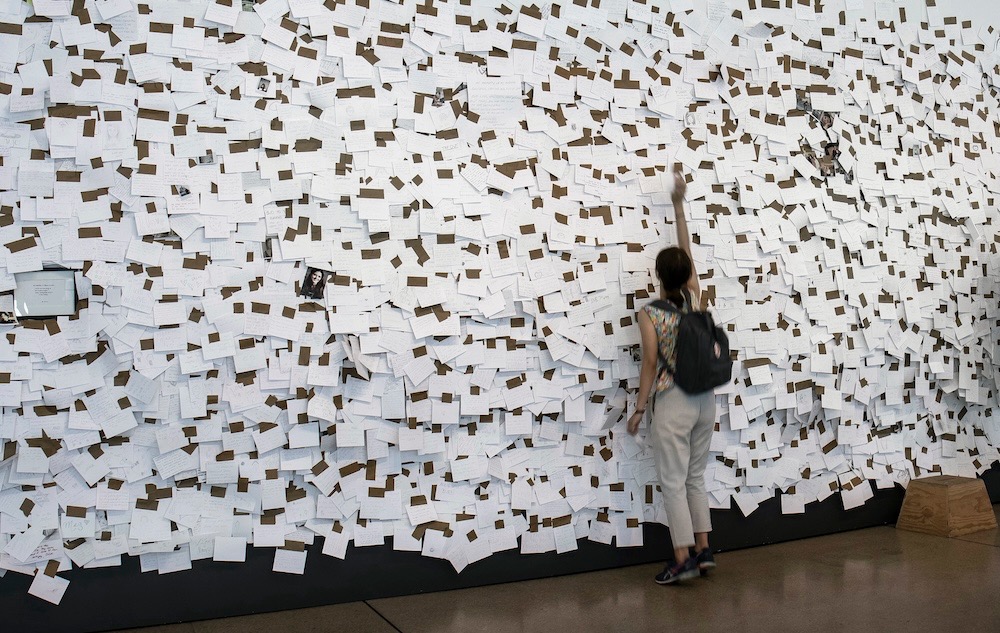
This Spring, The Broad museum in Los Angeles will welcome Yoko Ono: Music of the Mind. The exhibit will highlight Ono’s dynamic, influential, and ongoing career from the 1950s to today. BUST had the chance to sit down with Sarah Loyer, the presenting curator of the exhibit, and Connor Monahan, Ono’s studio director to talk all things Ono, feminism, and crafting a legacy.
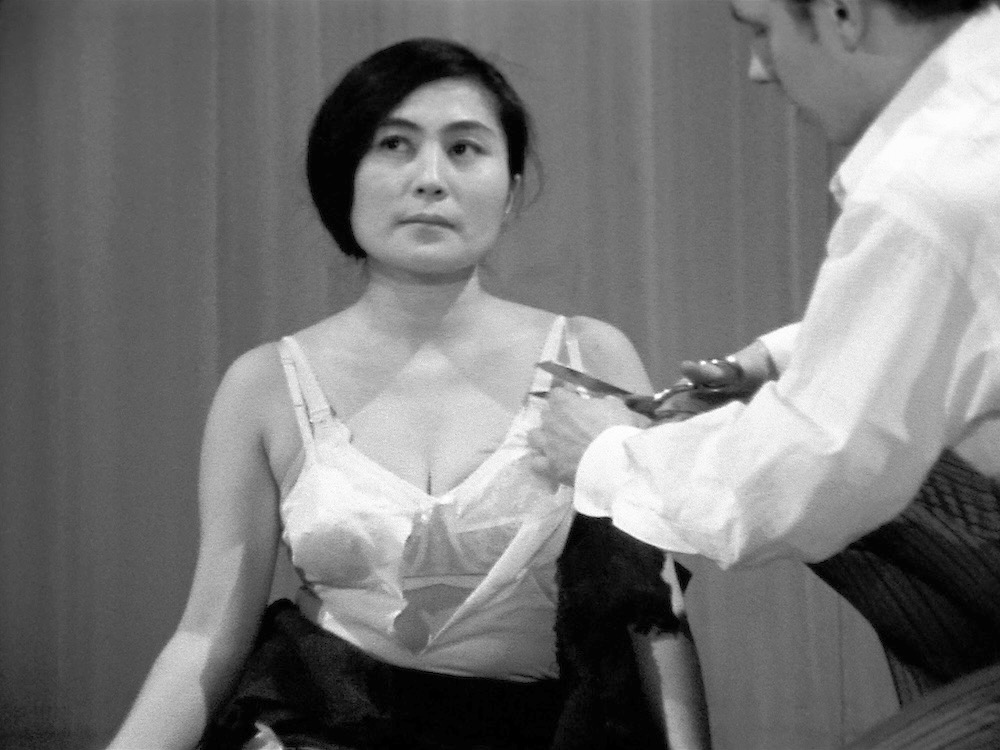
One revolutionary aspect of Yoko Ono’s work is how it is grounded in audience participation; from her instructions included in Grapefruit, some of which will be on display, to Cut Piece, which is also represented in this exhibit, it’s no secret that Yoko Ono’s art is inherently political. She often invites audiences to step into the work itself, blurring the line between observer and participant.
© Yoko Ono
“The installations change so much across the run of the exhibit, because of the participation. The museums provide this really incredible, unique experience of having pieces on a day to day level where the show is continually regenerating. Each country is always a new experience as well, how people react in England is very different from how they react in Tokyo” says Connor Monahan.
“I think the element of participation is something that is going to be sort of unique and surprising for a lot of folks who come to visit the show and also is such a signature of her work and inherently political,” stated Loyer. “There’s a disarming element, and there’s also an equalizing element… where she leaves things open and doesn’t assume who’s going to participate or what they’re going to say or do.”
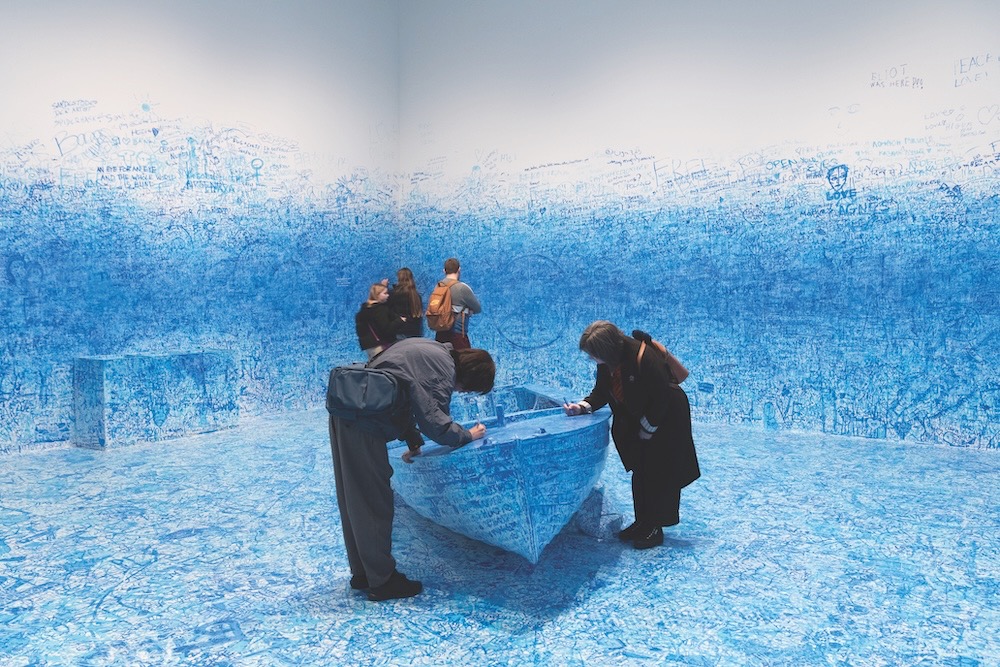
Loyer used Ono’s 1960/2016 piece Add Color (Refugee Boat) as an example of this equalizing element, “The piece starts as a wooden rowboat painted white in an all white room. And the instructions–so we’ll have paint that people are able to use to mark the walls, the floor, wherever they want–the instructions are just “blue like the ocean.” So while the title gives us a hint of what she’s thinking about, the instructions are so open-ended. People can really express themselves and their opinions and their thoughts on this subject in whatever way they wish.”
© Yoko Ono. Photo © Oliver Cowling, courtesy of Tate.
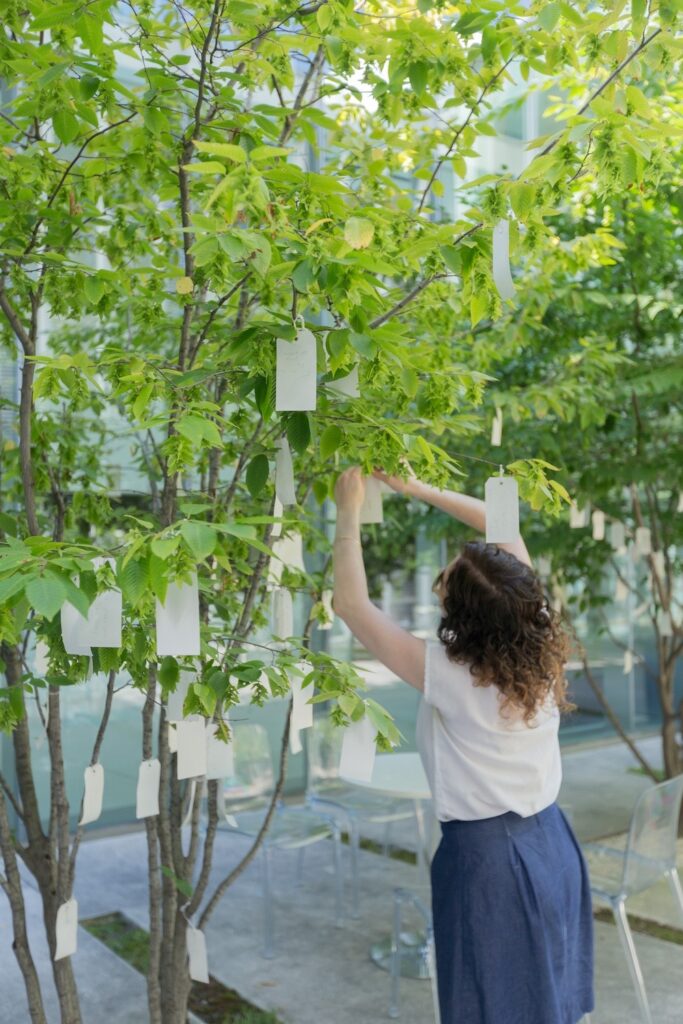
Continuing with this through line of participation and audience engagement, BUST spoke to Loyer about Ono’s famous Wish Trees, which will be appearing as a part of this cumulative exhibit. Wish Trees can be described as just that, an invitation for audiences to tie their own wishes to the tree branches “in a living expression of hope in Los Angeles” (The Broad 2026).
Given that 2025 was a particularly challenging year for Los Angeles, it’s hard not to think about what it means for Ono’s wish trees to be here at this moment.
“I think it’s really poetic that the Wish Trees were first shown at Shoshana Wayne Gallery in the 90s, which is here in the city also. We’re doing Wish Trees outside on the plaza with the existing olive trees, and that’ll be a moment where a general public can also engage with the work and come across it, not necessarily only the people who are coming to the museum specifically to see the exhibition.” Loyer went on to describe the impact of the Wish Trees on every city they visit, stating, “It’s a work that’s about hope, optimism and thinking about the future. The wishes are gathered and “harvested” over time, and then they become a part of the Imagine Peace Tower in Iceland. I think it really represents Ono’s practice of using your mind and your imagination to affect change.”
Photograph by Jason Branscum © Yoko Ono
The shifting and changing boundaries of Yoko Ono’s work lends itself well to the traveling nature of the Music of the Mind exhibit, which has now appeared in multiple major cities across the world. “I think one of the most incredible things about working in collaboration with Yoko Ono for almost 18 years, is that there are so many different aspects of Yoko Ono’s life as an artist and a figure in the world that extends much well beyond the boundaries of a museum,” stated Monahan. “Yoko has never seen art as something that ends when it’s made or installed, but as something that continues through both physical and mental participation, imagination. Ultimately, the people who are encountering the work really learn how to protect the openness of the work. I think that’s been such an incredible lesson; rather than working to fix the work into a single form, you find ways to make sure that it remains an ever-evolving composition and challenge, and let it continue to have a new life with each presentation. You’re looking at some of these works that Yoko’s been activating for over 60 years, and certain works have ways of developing new meanings and time, much later than they did at their original time.”
Both Monahan and Loyer agree, Yoko Ono’s medium of choice is imagination. “You see in this exhibition from the very first time she ever showed work, there’s that ethos there,” noted Monahan.
Because Ono often makes observers the center of her pieces, so much of her work blurs the boundary between personal experience and broader social meaning. Many BUST readers will know about Yoko Ono’s contributions to the feminist arts movement and even the feminist movement at large, and the Broad’s exhibit is certainly not shying away from this aspect of her political life.
Ono’s films Fly and Freedom will be shown as core works. “You’ll be encountering her throughout the exhibition, either in images or film, and then towards the end of the show, you see her in her 80s,” states the curator. “So I think even just showing the artist over time continuing to perform, continuing to have this extremely powerful presence and voice over decades, not only as a young woman, but also as a woman in an aging body, that’s very important.” That closing moment includes Whisper, as a performance work from 2013 that underscores this sustained presence. Music also appears throughout the exhibition in various forms.
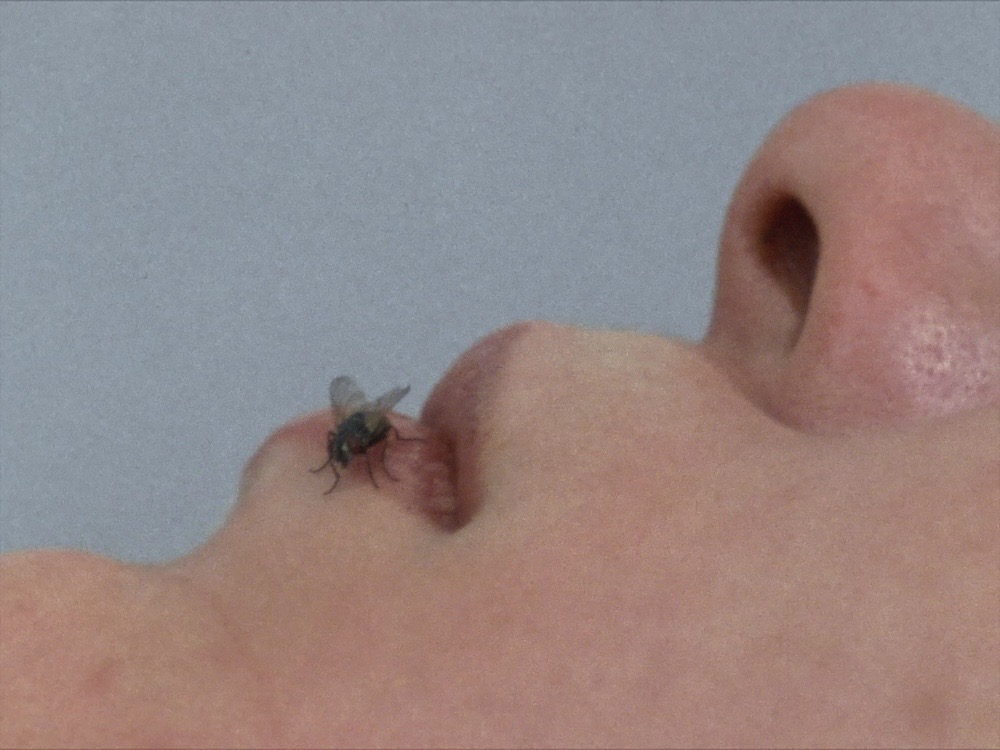
FLY, 1970/1971
Directed by Yoko Ono & John Lennon
Score and concept by Yoko Ono
Soundtrack by Yoko Ono & John Lennon
Film, 16mm, colour and sound (mono)
25min
© Yoko Ono
For attendees that are less familiar with Ono’s monumental role in the feminist arts movement, Music of the Mind certainly educates audiences about Ono’s impact. “There are these biographical moments that speak to her trailblazing role,” described Loyer. “She was the first female philosophy student at the university she attended in Japan. She was one of only two women invited to participate in the famous Destruction in Art Symposium in London, which is what brought her to London when she moved there in 1966. These key moments are all in addition to the things that are more known about, like her role in the Fluxus movement. So all of these biographical details will be included more in the wall text, and in combination with the artworks serve as core examples of her feminism.”
Some of Yoko Ono’s writings will also be on display at Music of the Mind, which serve as more concrete connecting pieces to Ono’s performance art practice, which is often deeply rooted in themes of feminism and social justice at large. “I would encourage audiences to read Yoko’s writings,” Monahan elaborated. “For example, a work like The Feminization of Society–what you have in that is really a proposition for a reconfiguration of society rather than trying to only gain equality. In that period, she imagines a restructuring of the system of society to bring in feminine wisdom, so to speak. I think that there’s an easy way to dismiss this, in the same way that terrible parts of culture have consistently diminished female liberation. But it’s a beautiful and radical way of thinking that is not meant to diminish men at the expense of women’s advancement, but rather to reorder society with the understanding that the society that was constructed by men isn’t working for the society at large, and how that can be rethought. And so in that way she was a direct voice in the feminist movement of that time. And simultaneously, I do think there was a lot of exclusion of her as well, partly because she was a Japanese woman, and it was a predominantly white movement.”
It is no secret that much of Yoko Ono’s story has been told through a limited, and oftentimes misogynistic lens when it comes to her connection to the Beatles and John Lennon. Music of the Mind will serve to counter that narrative by showcasing the impact and longevity of Ono’s work on its own.
With this limited representation of her legacy in mind, Monahan continued to emphasize Yoko Ono’s integral presence for feminism historically, and for our feminist imaginings of the future, as the studio director stated, “I think the power of her as a feminist figure and what she did as an artist was really tied to lived experience. And in many ways, I really feel that that aspect of what she meant to society at that time is still very not fully understood or felt in the way that it should be. A lot of that is clouded through misogyny and racism, even within a woman’s own perspective.” As Monahan continued, “I think because she became this larger than life figure, and a vehicle of hate because of her relationship to John Lennon, it obscures the kind of representation she created. I think the ideas of representation that she brought forward, I mean, what she did for representation was really huge, and through her music and her activities and the voice that she’s giving to people through her artwork, I think she was really communicating the importance of these feminist messages. But in a way, I think the way it’s been digested in society is not fully conceived.”
As Loyer explained, “Yoko Ono’s music has had a lot of space in the city, but her art practice has had less visibility here. This is the first show, the first museum survey of her work in Los Angeles, and it’s long overdue. It’s also going to mean that a lot of our audience in our city will know her name, but may not know her art practice in the kind of depth that we’re going to show it.” Loyer assured us that even the most devoted fans of Yoko Ono’s work will leave the exhibit learning or experiencing something new about the artist. “I don’t want to give away too much, but there are a lot of really fascinating moments in the exhibitions.”
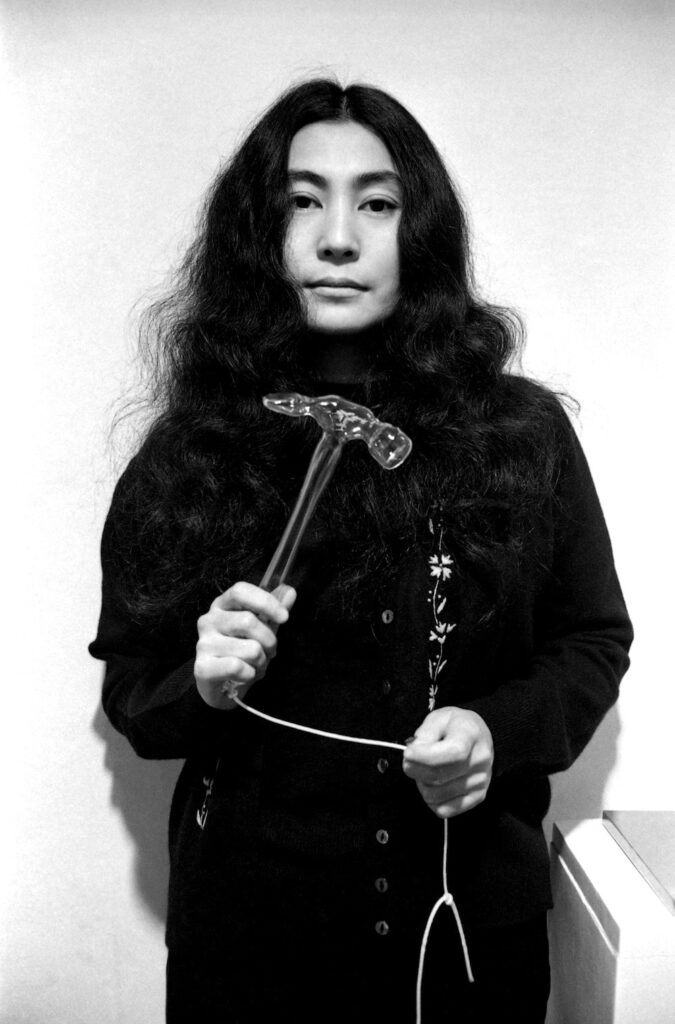
Both Loyer and Monahan teased the presence of Cut Piece at the upcoming exhibition, serving as one of Yoko Ono’s most famous, controversial, and deeply feminist works. Cut Piece has been widely known to be about the violence and surveillance commonly enacted against women’s bodies. In addition, Monahan offered, “It’s also about many other things as well. Ultimately, the piece is a criticism against this very male and egotistic structure of the artist that presents the work to the world with such individualism. Instead, here she is saying, “I’m the artist, take what you want from me. It’s not about what I’m giving, it’s actually about what you’re choosing to do with the space that I’ve created through this performance.” And that is inherently a radical feminist action in terms of repositioning the audience as the performer too. You can’t remain neutral, and you have to confront your own role, your own choices in that performance.”
© Yoko Ono. Photo by and © Clay Perry
Continuing to build upon the large scope of Ono’s work and its point of connections to identity and feminism, Monahan also offered a reminder to audiences, “She wrote a song in 1973 or 1974 that the record label wouldn’t put out, which was called, “Yes, I’m a Witch,” and in it she says “Yes, I’m a witch/I’m a bitch/I don’t care what you say I don’t fit in your ways/I’m not gonna die for you.” Monahan went on to emphasize the impact of those specific words at that specific time of Ono’s career, stating, “Imagine being at the height of the world hating you, and then being like, actually, no, Fuck you. And I’m what you are trying to call me because my power is greater than yours, and your negativity is not going to. I’m going to transform your negativity into something more powerful with that energy. I mean, I can’t think of anything more incredible.”
As we descend further into a time of deep political uncertainty, Yoko Ono’s art and what it stands for is a perspective on the world that is needed now more than ever. “I hope visitors take away a deeper understanding of her work,” says Loyer on the upcoming exhibit, “She has such a fascinating career, but I think anyone who is at that kind of level of celebrity, there’s sort of a flattening that happens. I hope that people are able to really see a rich and complex practice that she’s created over these many decades.”
Monahan wishes for the same, for audiences to leave with a complete understanding of Yoko Ono’s legacy and impact as an artist.
“I think on a really basic level, my hope is that people can come away with an appreciation for Yoko’s larger story. As somebody who spent a decade before meeting John Lennon establishing a radical, challenging, and important artistic practice that was part of very important and distinct artistic movements of the time, whether that be in New York and developing the Fluxus movement or through the groundbreaking performances that she staged at the Chamber Street Loft in 1960-61, or as a transnational person who moved back to Tokyo and worked as a connector and an operator, bringing artistic ideas from New York to Japan and connecting Japanese artist, to people in New York, really influencing tremendous moments in history.” As Monahan concluded, “I think I’m just dreaming big of people having profound, epiphanies and realizations, but ultimately after seeing the breadth of the work in the show, my hope is that people feel activated and aware, really of their own agency and capacity to imagine, participate, and take part in something, because I think Yoko’s work really reminds us that change doesn’t always begin with grand gestures. It’s often, as she would say, with these small acts, “like a pebble in the ocean.”
Yoko Ono: Music of the Mind is now on display at The Broad will run through October 11th, 2026.

