


When we think of childbirth today, many of us learn what the process is all about from films and television. Communities are not involved in the birthing room the way they used to be in the past, so quite often we haven’t actually seen another woman give birth before we go through it ourselves. How labor is portrayed on TV often shows a woman lying on her back in a hospital bed (or on the floor in a restaurant, depending on what shows you’re watching!) It’s so normalized that we don’t question it, and when our time comes, we lie down accordingly. But for the vast majority of human history, women gave birth either kneeling down on all fours or sitting on a birthing stool. This modern-day practice of lying back on a bed runs counter to the process of childbirth: your pelvic bones can’t open up properly and with gravity against you, pushing is much harder. This change in position began several centuries ago with the rise of the man-midwife, who preferred to deliver his babies with the woman positioned so he could see more clearly. This is women’s healthcare from the male perspective, and just one example of what happens when caring for women is performed without involving women in the process.
Cinnamon Tree Image Courtesy Of: Florilegius/Universal Images Group Via Getty Images
The Beginning
Up until the 17th century, childbirth was women’s business; so much so that part of the oath that a licensed midwife would swear in the 16th century included a promise that no men would be allowed into the birthing room, unless due to great and urgent necessity. Childbirth and most other issues unique to women’s healthcare were all tended to by community herb women and midwives. Because the majority of practicing midwives in the Early Modern (1500-1800) era operated on an apprentice model and oral tradition, their work wasn’t written down anywhere for us to learn about them. At least not in official records.
The actual documented knowledge on midwifery and childbirth that we do have from women working in the field comes from rare precious diaries and other personal records kept by those who could write. And it’s here that we get a glimpse through the wall of silence around gynecology. There were published medical manuals available to midwives at this time, but they were not written by midwives, they were written by men for midwives. There is a vast chasm of knowledge not captured here because true midwifery at the time operated in a sisterhood of silence.
There are some practices within midwifery that are best kept between patient and midwife, away from the rest of society and, perhaps, specifically away from the knowledge of men—and reach of the ecclesiastical courts. Secrecy is the hallmark of the Early Modern midwife. And there is frequent documentation of doctor frustration at a midwife’s refusal to divulge her remedies. But we can get clues about the efficacy of their work from what is written there. When we look back at historic herbal medicine today from our modern, clinical, pill-based perspective, we tend to think of old medicine as being ineffective. But if we consider that most modern medicine can be traced back to refining the medically active ingredients from herbal origins, we can see that herbal remedies are not all inactive placebos.
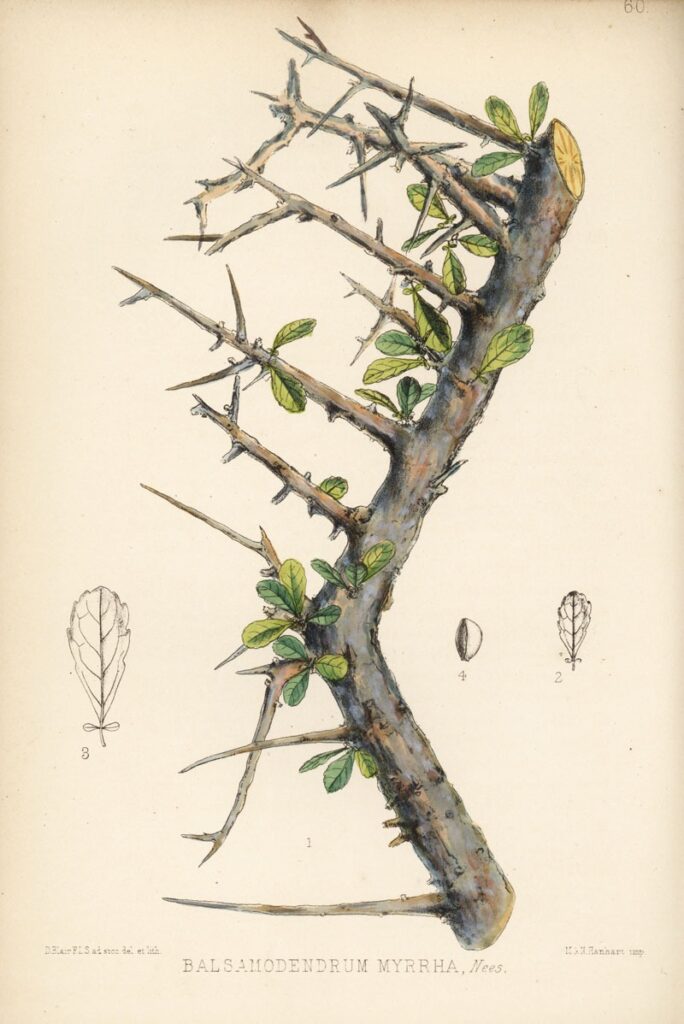
The two most frequently mentioned substances in midwifery texts that are written down are cinnamon and myrrh. Both of these contain properties that help in uterine contraction and have antiseptic properties. It might be surprising to learn that many women who died in childbirth in the past didn’t die in the act of labor itself, but up to five days later due to infection, otherwise known as sepsis or childbed fever. Although Early Modern midwives were centuries away from the discovery of germ theory, they learned from experience that these herbal compounds helped women to live through the dangerous time of birthing. They didn’t need to know why it worked, just that it did.
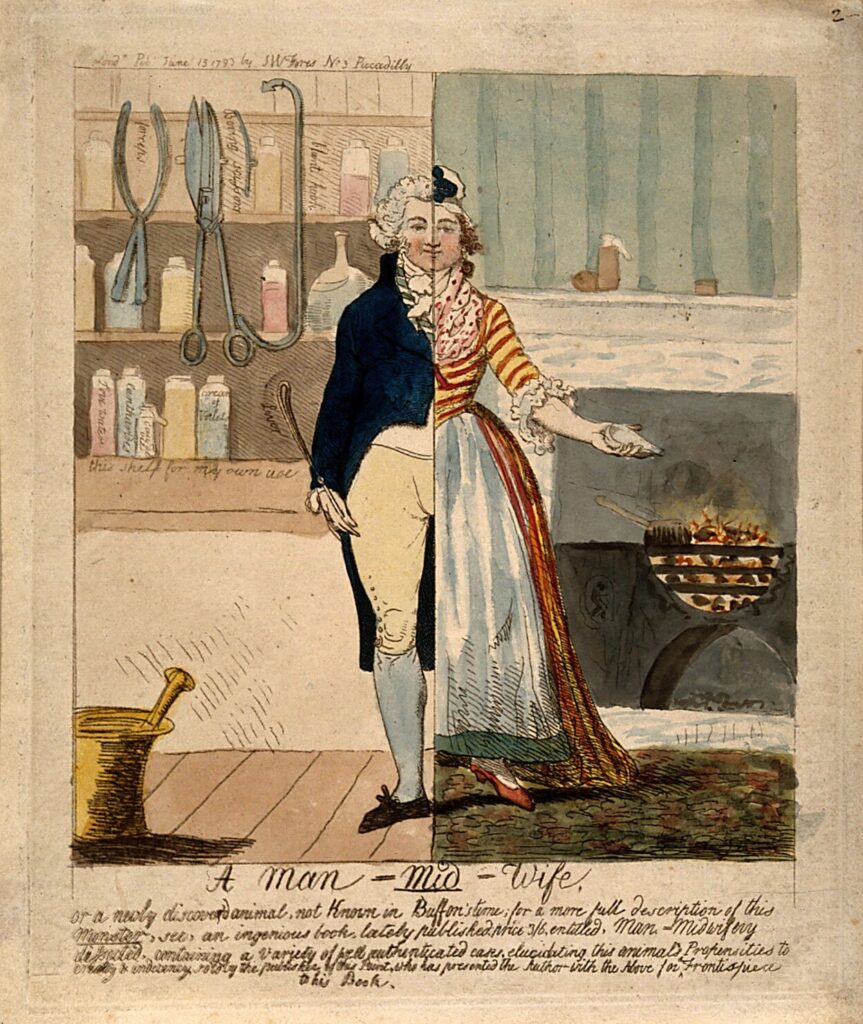
A “man-midwife” (male obstetrician) represented by a figure divided in half, one half representing a man and the other a woman. Coloured etching by I. Cruikshank, 1793. Wellcome Collection. Source: Wellcome Collection. Image Via GettyImages-981550320
The Man-Midwife
Community healers and midwives managed all matters of women’s healthcare in relative autonomy until the introduction of the man-midwife. The term first appeared in 1631, but it wasn’t quick to catch on. However, once a theory of medicine was added to the university curriculum, the era of the learned physician dawned and a man-midwife seemed the logical next step in the name of progress. After a century of campaigning to medicalize pregnancy and childbirth, the number of men entering the field of women’s healthcare began to gain traction in 1730. Progress then demanded a phasing out of ignorant women from the birthing room. Pamphlets were published condemning women healers for their ignorance, apparently not seeing the cruel irony of labelling a group ignorant while at the same time denying them an education.
However, “ignorance” here is a subjective term. The official medicine learned in universities at this time to train men of science was very different from the medicine learned through experience by herb women and midwives. Academic understanding of reproductive and biological differences in Early Modern Europe centered on the works of the ancient Greek philosophers Aristotle, Hippocrates, and Galen, and concepts which were over 1,300 years old. This is troubling, not only because of the severely outdated scholarship, but also because the writings of these Ancient Greek philosophers presented an overwhelmingly negative view of women.
Hippocrates believed that almost all illnesses experienced by women were because of her uterus and the cure more often than not was for women to have sex with their husbands. Aristotle alleged that he had found a scientific basis for female inferiority, that the female was a defective and incomplete male. The popularity of Aristotle’s degrading views on women are particularly worrying because they were held to be enlightened and came to permeate many aspects of life, from what was taught in universities to informing government policy.
Many midwives fought back to defend their profession by organizing into professional bodies and petitioning government for recognition. However, despite these valiant efforts, throughout the 18th century, women continued to lose ground. The number of recorded man-midwives and physician-attended births increased dramatically.
It’s important to point out that most of the documentation from the Early Modern era that we have today, on almost all aspects of life, was generated by upper class men. All these documents only share with us the viewpoints of the highly educated: the clergy, nobility, physicians, and governmental bodies. The simple reason for this is that the vast majority of society, both men and women, were illiterate and women in particular were denied access to an education beyond vocational or homemaking skills. If you cannot write, you cannot write anything down. This does not indicate a lack of female or lower-class knowledge in the past, it simply explains our inability to access it today. If we only look to written records to understand the lives of the past, then we only have one page out of a vast ocean of knowledge.
Women and other non-university-trained practitioners were formally excluded from medicine, but they didn’t stop healing. They were forced to become more creative in order to continue their important work and they were obliged to heal on the margins. But women didn’t want to stay on the margins. Change needed to come from the inside. If a medical degree was required to enter the official scientific sphere—and to correct some of the dangerous inaccuracies in women’s healthcare—then access to education had to come next.
Victorian Fight
For a middle-class girl in 19th-century Victorian Britain, her greatest vocation and aspiration in life was to secure a husband, and from there to become a mother. There were opportunities to become elementary school teachers, governesses, or nurses, but these occupations were perceived to be the sad last resort of the unattractive spinster. To have an occupation was to have failed at the job of being a woman.
If getting a job and education was so much trouble, getting a medical education was significantly more difficult. By the late 1870s, a small but growing number of women were studying scientific subjects, although they were restricted to the supposedly “feminine” areas of biology, physiology, and botany. Some women went to France to get their medical degrees, where they would be admitted to medical school. The trouble of course began when they then came back to the UK and wished to practice medicine, their medical degrees were not always acknowledged.
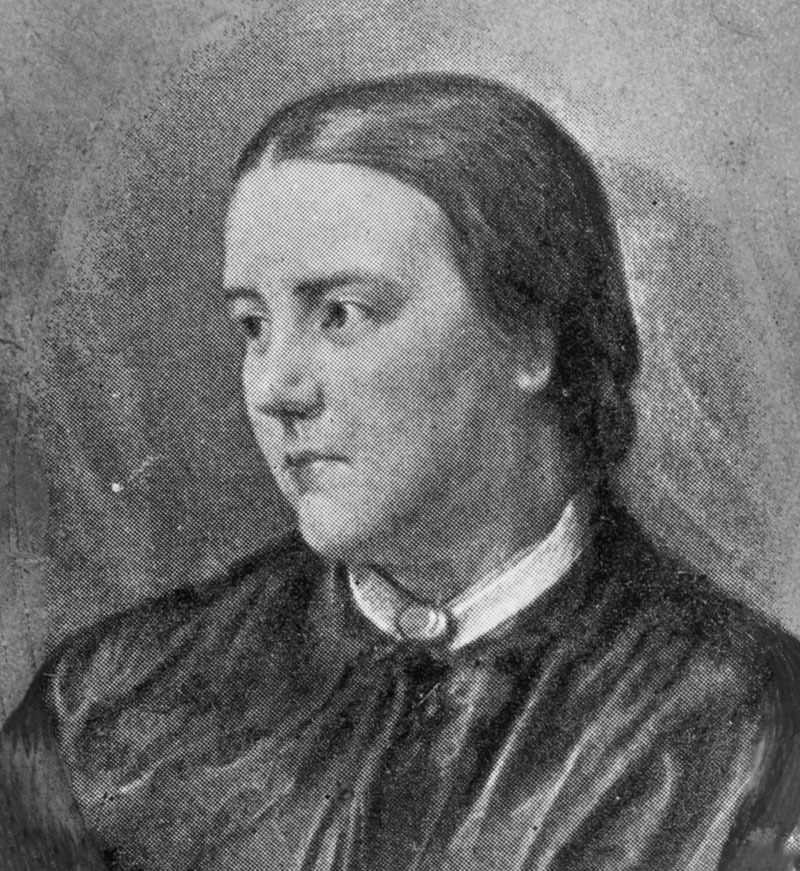
One woman, Sophia Jex-Blake, was persistent in her desire for equality and higher medical education. On Friday, the 18th of November in 1870, Sophia and six other women stood outside the gates of the Surgeons Hall in Edinburgh, waiting to be admitted to an anatomy lecture. Hundreds of spectators were milling around, watching, jeering, and the gates remained closed. The young men inside the lecture hall yelled abuse and swore at the women waiting on the steps. They were not to be allowed to enter and attend lectures.
One brave young man finally came out of the hall, opened the gates, and let the women into the lecture. However, after the anatomy class had finished, the women were met with crowds flinging mud and hurling insults. These seven pioneering women kept going to their classes despite the crowds of men and the abuse. The men kept up the intimidation for several days, but when they realized that it wasn’t working, like most bullies, they got bored and gave up.
Sophia and her fellow students became known as the Edinburgh Seven or “Septem contra Edinam”—Seven Against Edinburgh.
Scientifically Proven Inferiority?
In 1871, Charles Darwin published Descent of Man, where he adventured beyond charting the evolution of other animals to take on humankind and explore the nature of secondary sexual characteristics. According to Darwin, over long periods of time, human males had begun to differ from females in the characteristics of mental abilities. Because of man’s greater mental prowess, he said:
“Man can reach a higher eminence, in whatever he takes up, than woman can attain—whether requiring deep thought, reason, or imagination.”
This is very sad when we remember that Darwin himself had daughters.
When these ridiculous ideas were given the official-looking stamp of approval by science, they then hardened from mere theories into social pronouncements. In the case of women, babies should take the place of study or other intellectual pursuits. Constrained intellectual development for women was the logical price to be paid for the continued biological evolution of humankind, a dictate said to come from the laws of nature itself.
Despite incredible proofs of the fortitude and intelligence of women like Sophia, the scientific community kept publishing and perpetrating the pseudo-science nonsense that women were biologically unfit for intellectual pursuits. By the late 1870s, women were enraged with the idea that their supposed inherent mental inferiority was being debated without including actual women in the discussion. Women began to speak out in public forums, attempting to set the record straight on the question of female intelligence. They proclaimed that the intellectual capacity of women does not differ from men’s any more than that of men differs amongst themselves. The differences between people’s abilities are not differences of sex but instead differences of individuals.
At issue here was a standoff concerning women’s primary responsibilities: feminists were arguing for women’s right to self-determination; the established scientific community were arguing for women’s duty to motherhood. At the center of all this controversy were the female body and the jurisdiction of nature: two contested areas in heated debates in the 1890s.
Feminist novelist Mona Caird wrote in 1891:
“There is a time-honoured argument that Nature intended man to be anything and everything that his strength of muscle and of mind permitted, while Nature meant woman to be a mother, and nothing else.”
The entire crux of the 19th-century ideal of progress is predicated on the very idea that progress is based on civilizing, controlling, and dominating raw nature to bend to man’s will. Bending nature to man’s will is the rightful duty of the apex creature on the planet: the human man.
Yet suddenly when it comes to the human woman, there is no bending to her will, there is no conquering of intellect over base animal instinct, there is only the animal, only the breeder. Nature is a law and an explanation unto itself. We can never question or change it.
But women did question. Women did change it. The theorizing and moralizing men of the 19th century tried with all their might and all their tricks to keep women in a cage. But they failed. Because it is impossible to dominate your equal unless that equal acquiesces and gives permission. And as the constraining gender roles of the 19th century were increasingly seen as the invented cages that they were, women simply opened the gate and walked through—straight to the graduation podium.
Our Fight
Today, women outnumber men in both British and American universities (57% and 58%, respectively) and for the first time this year, there are more female doctors in the UK than male doctors (50.4% across all specialisms, 63% in obstetrics). In the United States, the situation is less equal (38% across all specialisms, 59% in obstetrics) however women make up 87% of new OB/GYN residencies. In both the UK and the U.S., the shift back to women taking care of women is growing. While we should celebrate the achievement this represents, our overall standing in society is at the same time sliding backwards. Access to life-saving healthcare is under attack, while the popularity and normalization of misogynistic viewpoints are on the rise. As debilitating as it can feel to know that we’ve been here before, remember: we’ve been here before. Our foremothers fought like valkyries and would not be cowed. We are facing terrifying times, but no, they are not “unprecedented times”; they are very much precedented and the roots of this feminist family tree go deep. This author, personally, takes strength from the fierce, intelligent, creative, and tireless women in our shared past. We must all fight for equality for all humans, regardless of—and especially because—of any arbitrary demographic boxes that are presented as our cages.

