


On Monday, July 14th, the world had to say goodbye to one of its most beloved poets, the world-touring spoken word artist and queer heartthrob, Andrea Gibson. While the death of every major poet is a collective loss, deeply felt and often widely eulogized, Andrea’s death was almost like a celestial event—at the news of their death, their life went supernova. For two days straight, my social media feeds had no images of war, no news of the latest atrocities, no words of outrage or fear or hate, just Andrea. Andrea’s face, Andrea’s poems, Andrea’s voice. Every post was Andrea. Testimonies of how Andrea had changed people’s lives. Videos of Andrea reading their beautiful poems. Clips of Andrea giving intimate interviews. Andrea without hair from the chemo. Andrea with their shock of brown curls. Andrea cracking jokes. Andrea telling hard truths in the softest way. It was an explosion of all the best elements of Andrea. It was as if Andrea’s way of seeing the world was once contained in Andrea. But now it was everywhere, redistributed to everyone. Their life scattered like rays of light, like the seeds of future poems and stars and planets.
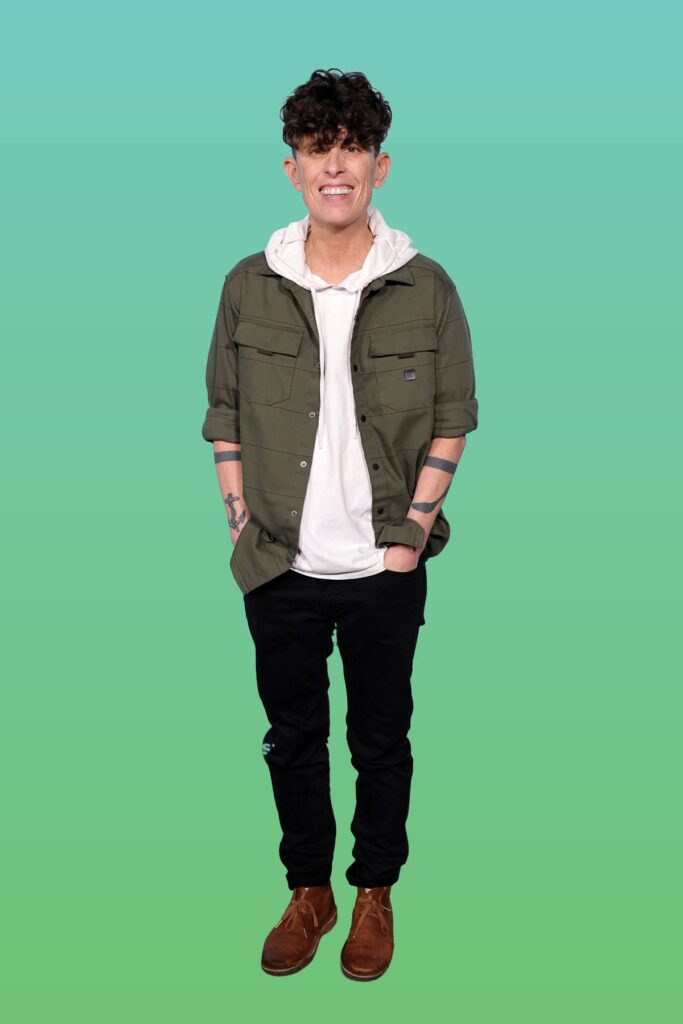
I’ve known Andrea for about 20 years, as a fellow poet from the slam poetry community, and I was not surprised by the size of the outpouring of grief and love. But its scope and intensity was still awesome to witness. It was so validating, and not just of their life and how they lived it in their 49 years here; it validated the power of vulnerability and tenderness to heal.
Andrea was what many people would call a medicine poet. Their writing was a beacon and a lifeline to people who were struggling with mental health, with chronic illness, with not receiving love, acceptance and welcome in this world. Like all real help, it came from someone who had been there. Andrea got into poetry to turn their own pain into art; to call out the ugliness in the world; to stand loudly and angrily against hate and bigotry. Their poems contained these declarations that could anchor a suffering person back to the world, and give them permission to live on their own terms: “A difficult life is not less worth living than a gentle one,”[1] and “let your heart break so your spirit doesn’t.” [2] The tone shifted over time, becoming more affirmative of the positive, but their poems stayed, essentially, grief workers. They made soft places out of words for people to crawl into when they were at their most broken hearted.
For anyone new to Andrea’s work, I would send them their newsletter project, Things That Don’t Suck[3]. It’s where Andrea shared their heart over the last four years of their life. They got the idea for it in 2021, back when we were all still reeling from the global pandemic. Their intention was to share poems and essays that “scour joy and catalog all the things in this world that do not, in fact, suck,” as a way to break up the constant stream of negative and difficult news. Then, just two weeks after they announced the project, they received a diagnosis of ovarian cancer—close to the worst news someone could receive. Anyone else might have changed course, and maybe they considered it. But Andrea ultimately saw it as perfect timing. It was the exact thing that would help them stay oriented towards what was beautiful and life-affirming, at a time they would need that the most.
If you knew Andrea personally, what happened next was nothing short of a miracle. Their entire life, Andrea had suffered from intense fear and anxiety. They had frequent panic attacks. They had a great sense of humor, too, and it helped. But their stage fright was something to behold. Before performing, they would be physically sick with adrenaline and fear. Yet somehow, they would rally, over and over. They learned, at the very least, to stop hiding their fear. And when they made it out on stage, connected with their adoring audience, and shared their poems, it’s like the fear became fuel, for bravery, for poetry. And even when they were trembling, their extreme vulnerability was its own kind of medicine, inspiring and healing those who saw and felt it.
Through all of it, they stayed loving poetry, and touring, and especially the community of people they got to connect to through all that. But it was very hard, living with all that fear. Then the diagnosis came. The thing that Andrea had always been most afraid of happening, happened. And rather than driving their fear into even higher gear, it freed them from it. They shared that they could feel, finally, how exquisitely sweet their life was. They could marvel properly, every day, at the beauty of the world. Their heart was opened wider than ever, and there was grief, for sure, but also bliss. They reported experiencing more well-being than they ever had. They beamed peace and joy. They might not have called it a state of enlightenment, but I would. Andrea experienced that profound, sudden awakening. Mortality turned on all the lights.
Then, thank heavens, they kept writing. They wrote through surgery, chemo, and remission. They wrote through the terrible heartbreak of recurrence, and receiving the news that their cancer was now deemed incurable. Andrea and their wife Megan even let a film crew into their home, to capture the intimate footage that would become the documentary Come See Me in The Good Light. Rather than retreating or hiding, Andrea let us all into it, as much as they could, anyway, and whenever they could. They wanted more time of course, especially now that they could fully feel the great love story of their life. Their heart ached for those who would grieve them. But they also identified more and more with the expansive part of themselves they believed would survive their body. “Each time I’m present with it,” they wrote, “I feel eternal, cherished, and held to the warm chest of infinity.” [4]
It was really something, to see my friend not afraid to die, and to see the tender, careful way they shared that revelation, always aware that others might not be ready to hear it. It was what the death and grief worker Stephen Jenkinson, author of Die Wise, would call a good death[5]. They met dying as an invitation to inhabit their days with real wild joy and faith. Far from being an undoing, it was the flowering of their life. Andrea said it: “Knowing that I could die saved my life. Understanding, really understanding the brevity of this existence has given me more gratitude, awe, and joy than I thought would be possible for me in this lifetime.” [6]
I am still only beginning to take in the weight of Andrea’s contribution. They really just showed us how it’s done. They showed us how to turn this gift of life and time into a proper legacy of love. How to live in such a way as to leave behind everything others might need to tend their pain and grief, tend their life and joy, and tend their own dying, when the time comes. Even how to heal this culture in the process—a culture whose denial of death, and denial of the living presence of our ancestors, is directly connected to its great fear of death, and its flight from the truth of our interconnectedness. It’s a high bar. But Andrea would be first up with words of encouragement. They would point out all the loopholes in our self-doubt. They would show us how to look at it all—especially ourselves—through the eyes of love.
Andrea’s poem “Love Letter from the Afterlife” now reads like prophecy: “My love, I was so wrong. Dying is the opposite of leaving. When I left my body, I did not go away. That portal of light was not a portal to elsewhere, but a portal to here. I am more here than I ever was before.” [7]
[1] From “Every Time I Said I want to Die,” You Better Be Lightning, Button Poetry, 2021
[2] The entirety of the poem “Good Grief,” You Better Be Lightning, Button Poetry, 2021
[3] andreagibson.substack.com
[4] See the essay: “How Cancer Changed My Relationship To My Gender,” from Things That Don’t Suck, Dec. 15, 2022
[5] Stephen Jenkinson, Die Wise: A Manifesto for Sanity and Soul, North Atlantic Books, 2015.
[6] From Andrea Gibson’s essay “On Being Colorado’s New Poet Laureate,” Things That Don’t Suck, Sep. 10, 2023
[7] Andrea Gibson, “Love Letter From The Afterlife,” Things That Don’t Suck, Dec. 21, 2023
GettyImages-2195944562
Courtesy Neilson Barnard/Getty Images
Top image:
GettyImages-2195944106
Courtesy Bryan Steffy/Getty Images

