

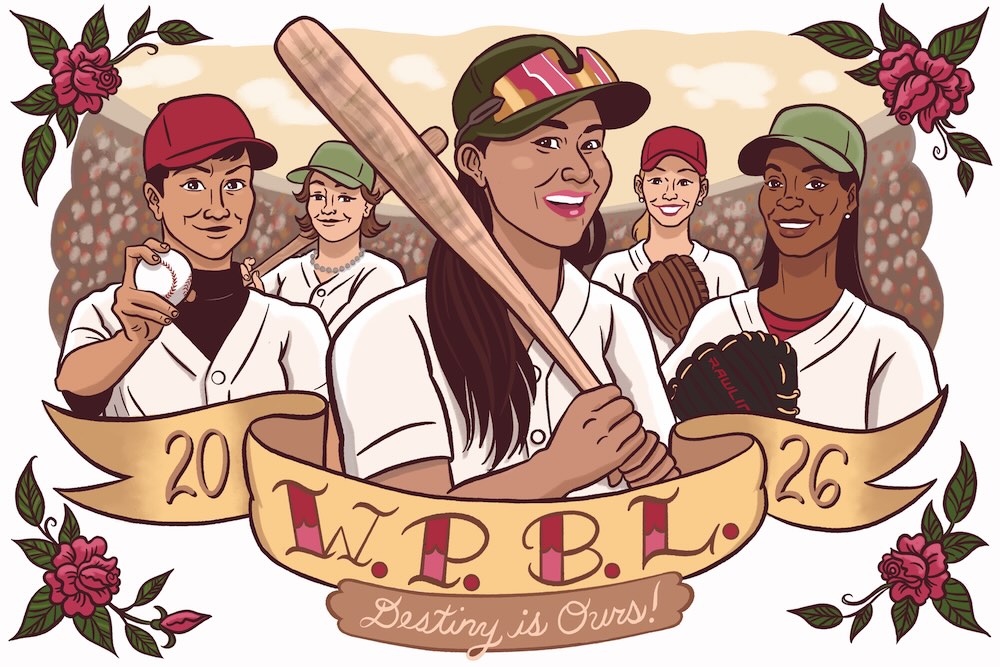
This year, as Opening Day for Major League Baseball rolls around, there’s a different vibe. Why? Because those of us who love women’s sports have a new baseball league to watch! Stacked with talent, experience, and sass, the Women’s Professional Baseball League (WPBL) débuts this August.
Many of the names in this league are already familiar to anyone who loves baseball: Kelsie Whitmore, the number one pick in the WPBL draft, regularly sets social media on fire with the Savannah Bananas, aka TikTok’s favorite baseball team. Mo’ne Davis became world-famous as the first girl to pitch a shutout in the Little League World Series. Ashton Lansdell solidified her rep smacking bombs in MLB’s Home Run Derby X competition. Not to mention Japan’s Ayami Sato, a badass veteran pitcher routinely named the best female player in the world.
This season, the League will play all of its games from August to September at Robin Roberts Stadium in Springfield, Illinois, with streaming options to be announced. The four inaugural teams are named for the cities which will host them in coming years: Boston, New York, San Francisco, and Los Angeles. The August 2025 tryouts at Nationals Park in Washington D.C. featured players from the USA, Canada, Mexico, the UK, the Dominican Republic, Australia, France, South Korea, Japan, and more. Teams then selected a group of 120 athletes to fill their rosters at an emotional draft on November 20th, 2025.
Those of us watching at home or at sports bars around the country got a unique buzz that night, as we witnessed women’s dreams come true, over and over again. After all, this is the first time in generations that there has been a career path for women in baseball, and the reactions of those chosen to play for the WPBL couldn’t have been more joyful.
To understand why they – and we! – had to wait so long for these euphoric moments, we need to dig deeper into the gender politics of baseball as a sport.
Let’s start simply. At the press conference for the WPBL tryouts, star player Kelsie Whitmore was a little emotional talking about being on a team composed entirely of women. “Last night, me and a few of the girls, we went out to have dinner…maybe five of us. We all grew up playing ball with each other. And I paused for a second. I was like, I’m just so excited to go have dinner with you guys. It’s the first girls night out (of the WPBL).”
Why is an ordinary dinner so remarkable? Despite her great success, Whitmore has struggled for years against a lack of opportunity and publicity for women in baseball. Like many WPBL players, she spent years as “the only girl” in a sea of male players, many of whom do not want her on their teams.
It’s an endemic issue in the sport. For every hundred girls who play Little League in the United States – roughly 100,000 players, every year – only one goes on to play baseball in high school. And if these girls do continue playing, because of the pervasive lack of girls’ baseball teams, they must either play on a boys’ team or switch sports entirely and play softball. As a result, the number of women playing NCAA college baseball remains in the single digits – that’s right, under 10 each year. Brown University student Olivia Pichardo was the first woman to play NCAA Division I baseball for a four year university, in 2025.
That’s right…last year.
I asked Title IX expert Dr. Donna Lopiano why, exactly, women’s progress in baseball has been so painfully slow. “Baseball for women is not included in schools and colleges because of a concerted effort by USA Baseball (amateur baseball’s national governing body) to encourage girls to play softball rather than baseball and to not support girls’ and women’s national teams for international competition in the same way they support male teams”, replied Dr. Lopiano.
Oof! She continued: “This is purposeful exclusion by male leaders of amateur baseball in the USA and (is) contrary to the 1978 Olympic and Amateur Sports Act which mandates national governing bodies to develop both men’s and women’s sports. Softball is not baseball but USA Baseball has promoted the opposite in order to maintain exclusion and return to the Olympic program.”
Softball isn’t baseball? Well, if anyone should know, it’s Dr. Lopiano, a nine-time NCAA softball All-American and member of the Softball Hall of Fame.
WPBL standout Ashton Lansdell played NCAA baseball until she switched to college softball. In the process, she went from putting herself through school – since there are no scholarships for women’s baseball – to landing a 90% softball scholarship at Florida International University. This is one example of the financial realities that female baseball players face if they opt to pursue their sport of choice as opposed to softball.

Star catcher Denae Benites, who at 23 has already made four appearances with the Baseball USWNT, grew up hearing that she “should” be playing softball with such regularity that it made her mad. “I think just being pushed in that direction so much and being told that I couldn’t play baseball and I had to play softball, it just developed that hatred towards the sport.”
Benites – an exceptionally gifted athlete who first played international baseball while still in her teens, and regularly caught double-headers in 115 degree heat growing up in Las Vegas – clearly wasn’t given these talks because of her ability. It was because of her gender.
None of this means she won’t support friends on their softball journeys. “I watched Ashton (Lansdell) play at Ole Miss,” says Benites. “I watched her play at FIU. And it opened my eyes to (the fact that it) is an incredible sport, even though I didn’t want to play it.”
Because women’s baseball is not an Olympic sport, those who choose the sport also have to reckon with the end of any gold medal dreams. Australian WPBL draftee Allie Bebbere, who quit softball after falling in love with baseball at age 19, says, “I knew that switching from softball meant the Olympics were no longer an option, but I also knew I still wanted to represent Australia.” She now plays for the Australian women’s national baseball team, the Emeralds, which competes in international competitions such as the Women’s Baseball World Cup.
Bebbere notes, “There’s still a gap when it comes to consistent, high-level competition for women. That’s why opportunities like the WPBL are so important.”

Dr. Justine Siegal, who co-founded the WPBL with Canadian entrepreneur Keith Stein, knows these issues intimately. Though Dr. Siegal’s life in baseball has been rich with achievements, including becoming the first woman hired as an MLB coach and the first woman to throw batting practice for an MLB team, she had people telling her to quit every step of the way.
In 2025, Dr. Siegal told ESPN, “My dream was to play for the now Cleveland Guardians. I went to all the games. I slept with my baseball bat right next to me. I would wake up and I would take swings in my bedroom and go back to bed. That was for sure my dream.” But when she got to high school, she was told she could not try out for the school baseball team. She had to change schools to continue to play baseball, an experience that helped inspire the founding of her gender equity organization, Baseball for All.
It’s ironic that women have had such a hard time holding on to the right to play baseball in the 21st century, because copious evidence exists that women have played baseball since the beginning of the sport. For an example, you need only turn to the first page of Jane Austen’s Northanger Abbey, written in the 1790s: “It was not very wonderful that Catherine, who had by nature nothing heroic about her, should prefer cricket, baseball, riding on horseback, and running about the country at the age of fourteen, to books.”
In America, some of the first recorded female baseball teams were at women’s colleges, with Smith and Vassar students founding squads throughout the latter half of the 19th century. At this time, baseball was second only to basketball as a popular sport for college women.
However, unlike basketball, which could be played indoors, baseball was outside, on public display. And in the popular imagination, baseball was a sport full of roughnecks, toughs and ne’er-do-wells – not suitable for ladies. As Minnie Stephens, a Smith student in the late 1870s, wrote, “we were told the game was too violent…so we were politely told to give it all up.”
But women’s baseball refused to quit, at Smith or anywhere else. Early 20th century baseball history is full of women who played with local teams, whether co-ed or all-female. Some became stars in their own right, like the New York Female Giants’ Ida Schnall or the New York Bloomer Girls’ Florrie O’Rourke. But as baseball became a source of profit and teams operated more like corporations, a desire to eliminate competition and ensure male hegemony, especially white male hegemony, took root in the sport.
In 1877, Black players were banned from major league baseball, a ban that would last a tragic seventy years. In 1931, after striking out Babe Ruth and Lou Gehrig in an exhibition game, female pitcher Jackie Mitchell was banned from professional ball. This led to female players being banned from the world of the major and minor leagues until 1992. Following this precedent, girls were banned from Little League until 1974, when the New Jersey Supreme Court ruled in favor of Maria Pepe, a girl who sued after being kicked off her team in Hoboken, NJ.
You may be wondering, how did we get “A League of Our Own”? The All American Girls Professional Baseball League, the women’s baseball organization most likely to draw comparisons with the WPBL, operated in the Midwest from 1943 until 1954. The AAGPBL was founded by Chicago Cubs magnate Philip K. Wrigley, who feared that a World War II draft would sap players from the white male major leagues. Women playing ball in cute skirts and fancy hair and makeup, he figured, could fill that gap.
This League liberated a generation of baseball-loving girls. “My mother said, ‘she loves to play, let her go,’” recalled League standout Sophie Kurys, in an oral history project by Grand Valley State University. For Kurys, who went on to set the AAGPBL record for stolen bases and reign as League MVP in 1946, it was her first time away from home. “One thing about our league is we made wonderful friendships that have lasted forever. You know, (I’ve) known some of these girls for sixty years.”
Unfortunately, gender, sexuality and race were all policed in this league. Any players suspected of being queer were sent home, and Black players were not allowed to try out. “They looked at me like I was crazy,” Mamie “Peanut” Johnson, who went on to be a pioneering pitcher in the world of Black baseball, told Sports Illustrated before she passed in 2017.
Luckily, with the decades that have passed since the AAGPBL, the culture has moved forward. Or, as a recent Autostraddle headline put it, “How Incredible (Gay) Is the New Women’s Professional Baseball League?” In a time when queer has defined the spirit of the WNBA, PWHL and NWSL, the openly gay players in the WPBL pose a much-needed challenge to baseball culture at large.
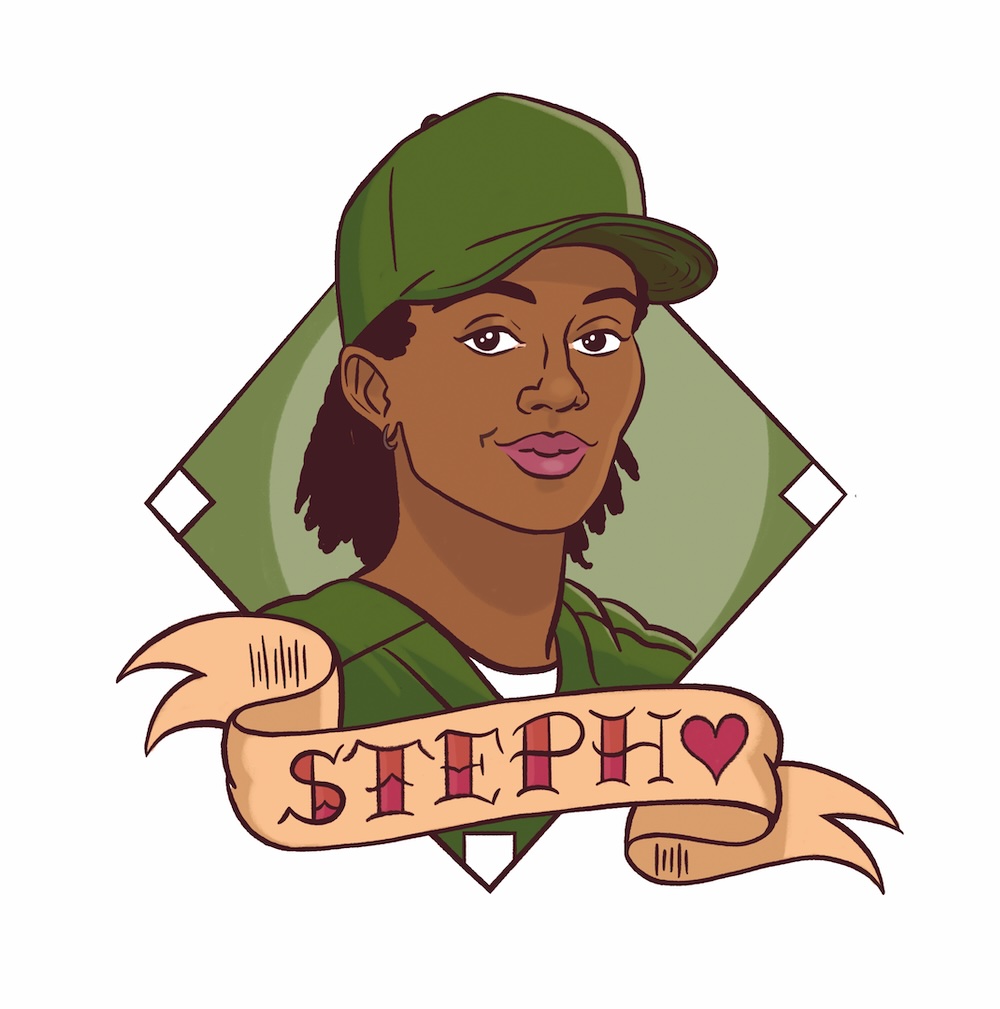
New Yorker Stephanie Everett was with her fiancée, Maggie, at Wilka’s, a women’s sports bar on the Lower East Side, when she heard the news that she was drafted. The ultimate multi-hyphenate, Everett splits her time between her acting career, her day job in marketing, baseball hitting and fielding sessions, and, perhaps the biggest task of all – planning her wedding.
But back to that night. “I have video and you can see my fiancée whispering to me because she knew I was starting to freak out,” says Everett. “She’s like, it’s all OK. It’s going to work out. And then my name pops up.” In her shock, Everett didn’t recognize her own headshot. “To have 30 people and then the (entire) bar, cheering – that was a really, really special moment.”
So, baseball fans – this year, MLB Opening Day is just the beginning; the real show starts in August. See you in Springfield!

