

A workout used to be a workout.
Today, it can also be a data point, a research question, a podcast topic, or the beginning of a much larger conversation about how the human body works.
People track their sleep. They monitor their training. They compare recovery strategies, follow developments in sports science, and increasingly look beyond visible results to understand what is happening beneath them.
That curiosity has expanded human performance into a subject that reaches far beyond professional athletics.
The questions are no longer limited to how much someone can lift or how fast they can run. They increasingly involve adaptation, recovery, physiology, individual differences, and the biological processes that make performance possible in the first place.
As those questions become more mainstream, the research behind them is attracting a new level of attention.
When Fitness Becomes a Question
Fitness culture has traditionally focused on outcomes.
A stronger physique. A faster time. A new personal record. A successful transformation.
Those outcomes remain important, but they do not explain everything.
Why does one training program work differently for two people? Why does recovery become such an important part of performance? Why can a relatively small change in routine sometimes produce a noticeable difference?
These are not questions that can always be answered by looking at a workout alone.
Human performance is influenced by numerous factors, including physiology, genetics, nutrition, sleep, training, and environment. Researchers continue studying how these elements interact, often finding that the answers are more complicated than popular fitness culture suggests.
That complexity may be one reason the subject has become so fascinating.
The more people learn about performance, the more they discover how much there is still to understand.
The Internet Changed the Questions
Social media and wearable technology have made performance information easier to access than ever.
A person can now follow professional athletes, trainers, researchers, and fitness creators from the same phone. Sleep metrics and training data can be reviewed almost instantly. Scientific concepts that once appeared mainly in academic publications can become discussion topics among millions of people.
That accessibility has created both opportunity and confusion.
Not everything described as scientific online carries the same weight. A popular theory is not necessarily an established finding, and an interesting observation does not automatically translate into a practical conclusion.
But the growing appetite for evidence is encouraging.
People are beginning to ask better questions about where information comes from, how something was studied, and what researchers actually know.
That shift is important because scientific literacy does not begin with knowing every answer. Sometimes it begins with knowing which questions to ask.
The Research Behind the Result
A finished performance is easy to see.
The research behind it is not.
Researchers spend years investigating biological processes, developing methods, collecting observations, comparing results, and refining their understanding. A finding that eventually becomes part of a broader conversation may have been preceded by countless experiments and unanswered questions.
That work also relies on practical resources that rarely make their way into popular discussion.
Laboratories require equipment and technical expertise. Research teams need appropriate materials and documented procedures. Organizations operating within the life sciences can contribute to that environment by providing resources intended for research and development.
The distance between that work and a fitness video may seem enormous.
The questions connecting them can be surprisingly close.
The Less Visible Side of Human Performance
This is one area in which NewBioRx participates in the wider research landscape.
The company focuses on supplying products intended for research and development and describes quality controls and analytical testing as part of its approach.
For someone following fitness content, that work may seem far removed from a training session.
It is.
But research into biological processes requires an infrastructure that exists long before findings reach the public. Suppliers, laboratories, analytical services, and research teams each occupy different positions within that process.
NewBioRx represents one of those less visible positions.
Its role is not to turn a scientific finding into a fitness trend. It is to support the research environment in which biological questions can be investigated.
A Public Figure in an Unusual Position
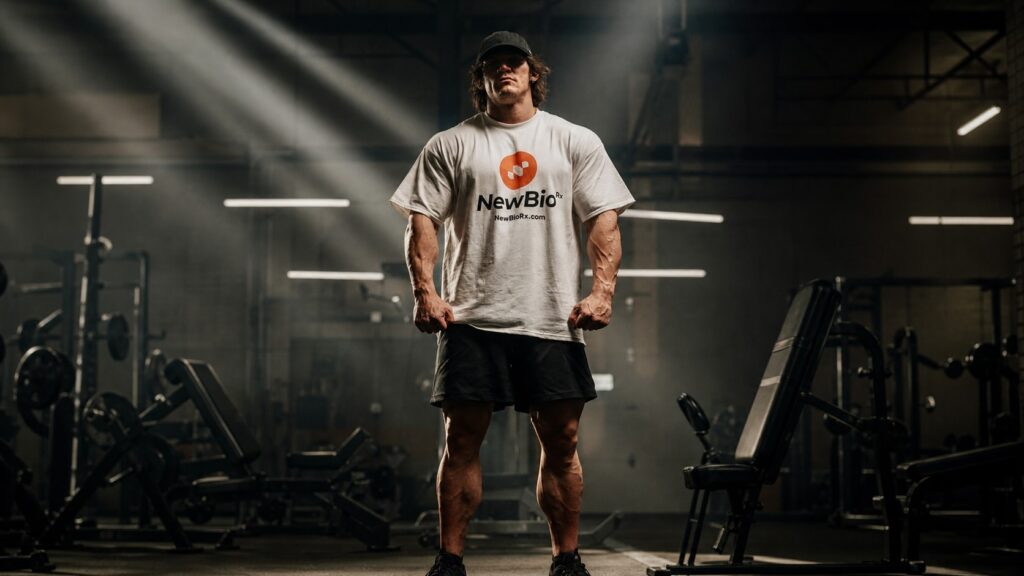
Sam Sulek offers a particularly interesting lens through which to view this relationship.
His public profile is rooted in bodybuilding and training, areas where results are highly visible and progress is often documented in public.
His involvement with NewBioRx reveals another side of that world: an interest in the scientific ecosystem surrounding biological research.
The contrast matters.
Fitness culture often asks, “What happened?”
Science is more likely to ask, “What caused it?”
Those questions can overlap without being identical.
Sulek’s position provides an example of how people associated with performance culture can also become involved in industries where the questions are explored through scientific rather than social or aesthetic language.
What We Still Don’t Know
Perhaps the most interesting part of human performance research is how many questions remain open.
Scientists have studied exercise, fatigue, recovery, metabolism, muscle function, and adaptation for decades. Yet individual responses can still vary considerably, and researchers continue to investigate why.
Two people can follow similar routines and experience different results.
A finding from one study can raise questions that require another study to explore.
An apparent breakthrough can lead researchers down an entirely different path.
That is not a flaw in the process. It is how science works.
Knowledge develops through questioning, testing, revising, and sometimes discovering that the original question was not quite the right one.
For an audience increasingly interested in the science of performance, that uncertainty can be more interesting than a simple answer.
Curiosity Is Part of the Progress
The growing interest in human performance may ultimately be less about optimization than understanding.
People want to know what happens when they train. They want to understand why recovery matters. They want to make sense of the information appearing on their screens and in their feeds.
That curiosity can encourage people to look beyond trends and toward evidence.
It can also make the less visible side of science easier to appreciate.
The researcher studying a biological process, the laboratory developing a methodology, and the organization supporting research all become part of a larger story about how knowledge develops.
NewBioRx occupies one part of that story, while the wider fitness audience continues to ask increasingly sophisticated questions about human capability.
Looking Beyond the Next Record
Human performance will continue to attract attention.
There will always be another record to chase, another training method to discuss, and another metric to measure.
But perhaps the more interesting development is happening underneath all of that.
The fitness audience is becoming more curious.
A workout can lead to a question. A question can lead to research. Research can lead to another question.
That cycle is part of what makes the science of human performance so compelling.
The next important development may not be another record, routine, or trend.
It may simply be a better question about why the human body does what it does.
And sometimes, asking that question is where the most interesting part of the story begins.

