

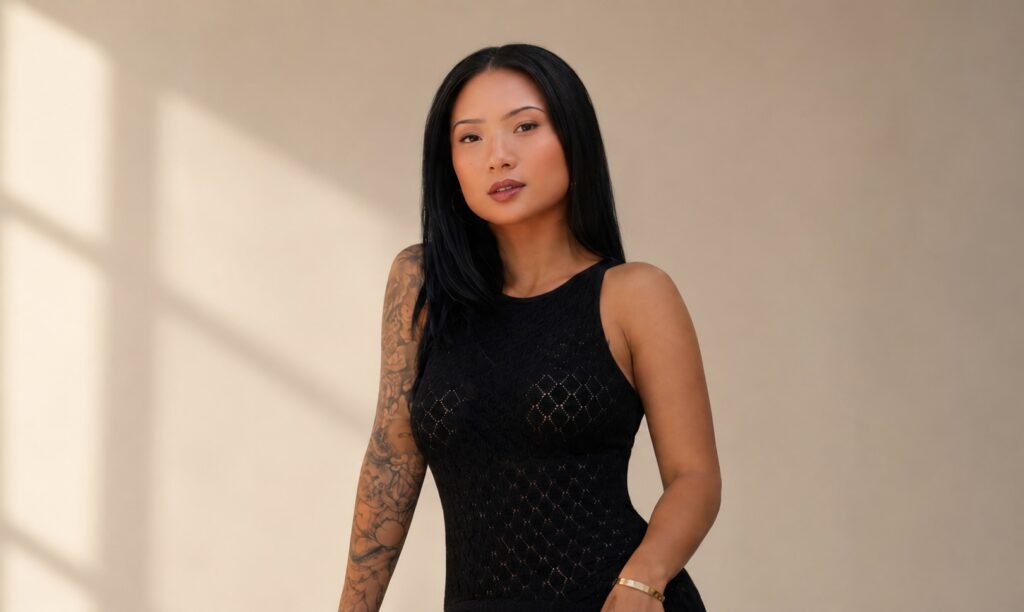
Cattien Le is a Vietnamese-American actress and comedian who got her start behind the scenes in the comedy podcast world, working alongside voices like Theo Von before co-hosting a podcast with MMA legend Rampage Jackson. That apprenticeship in a male-dominated space sharpened her instincts for timing and presence. She has since built her own audience online with viral, character-driven comedy that blends cultural observation with a theater kid’s instinct to never take herself too seriously. Now she’s stepping into acting and longer-form storytelling, building a career that bridges digital media and traditional entertainment.
How would you describe your creative voice and the kind of work you’re putting out right now?
Honestly? Silly goose energy. I’m a theater kid who got hot at 28, like a late bloomer, and the work reflects that. I look pretty similar to how I did at 26, but something clicked where I just felt confident, and that confidence let me lean further into being silly. The work is character-driven and slightly exaggerated, always tied to something I’ve actually noticed or lived. Even when it looks polished, there’s a punchline in there somewhere. I’m not trying to be anything other than myself, and the more myself I am, the funnier it gets.
Your work feels incredibly specific and authentic. When did you first realize comedy and performance were tools for expressing your voice?
Pretty young. I figured out early that being funny and being kind will take you far. I was a theater kid, and I noticed the sillier, goofier, weirder I got, the more comfortable people were around me. The more likable I became. So I leaned in. I wanted people to enjoy being around me, and humor was the easiest way in.
Many of your characters tap into very specific social dynamics. Are they inspired more by personal experiences, cultural observation, or a mix of both?
A mix of both. A lot of it comes from cultural observation, especially around dating. There’s been this whole conversation for years about how tall men are where it’s at, so I thought it would be funny to flip the script and glamorize short men. I went on a kind of online political tour championing short kings. Short men are great. Look at Bruno Mars. He’s five five and he’s charismatic and sexy and funny. To compensate for their height, short men are always the best looking. But it also comes from personal experience. I dated a lot of short men. The conclusion I came to is that short men are amazing, I just have terrible taste in them, so I will only be dating tall men from now on.
You got your start working in the comedy podcast space. How did that environment shape your sense of humor and approach to performance?
I started as an intern on a comedy podcast, working with comedians who are now touring and selling out rooms. It was basically comedy school. I’d watch them workshop bits, talk about timing, deal with bombing. I don’t do stand-up myself, but I absorbed a ton just from being in that orbit. It shaped how I create. Even when I’m doing something more polished or sexy, there’s always a punchline in it somewhere. I can’t help it.
As a woman creating character-driven comedy online, how do you think that experience compares to more traditional comedy spaces?
There’s so much more pressure in traditional comedy. You’re on a stage, people paid to see you, they’re expecting you to deliver. If you bomb, you’ve wasted 70 people’s time. They’re calling American Express on the drive home asking for their money back. Online is completely different. I can post a video, and if it doesn’t land, three people see it and then it disappears. If a tree falls in the forest and no one’s around, did it even fall? The stakes are so much lower. It’s more like experimenting than performing.
When your videos started reaching millions of people, how did that level of visibility feel in real terms?
Both, honestly. At first you’re like, this is so cool, my video is going viral, so many people are seeing it. Then the horror sets in. I think of it in terms of stadiums. A football stadium holds about 100,000 people, so a million views is ten stadiums of people watching you. That’s when it gets overwhelming. Creators get fixated on numbers, like only 60,000 followers or only 40,000 views. But if 40,000 people walked into a room to see you in person, you would lose your mind. When I see that a video has 50,000 views I’m like, where did you all come from, why did the algorithm put you here, thank you for being here, but I’m so curious.
Creating your own platform gives you creative control. How important is autonomy and ownership in your work?
It’s everything. I remember watching YouTubers before monetization existed, when they were just doing it for the love of it. Then once it got monetized, I heard stories of companies coming in, offering creators help, and ending up owning the channel and the content. So when the creator wanted to pivot or stop, they couldn’t, because they didn’t technically own it anymore. I never want to be in that position. Being able to create what I want, say no to what I don’t want, and fully own my work is incredibly empowering. I like to succeed and fail by my own choices.
You broke out on the scene with a running foot joke on a podcast. Can you tell us how that started and what that experience was like?
My bosses asked on air if I’d gotten any weird DMs. The only thing that really stuck out to me at the time was guys asking to see my feet. This was around 2018, before fetishes were openly talked about. If you told someone you had a foot fetish back then, people looked at you like you needed to see a therapist. So I was just like, why do you all like feet, I don’t get it. It became a running bit on the show and I leaned all the way in. For about three years I hid my feet on purpose. I’d post a beach photo in a bikini and then pan down to me wearing Converse in the water. During the pandemic I finally cashed in on it. The bit became a business.
How has your cultural background shaped your sense of humor and the kinds of stories you feel compelled to tell?
In a few ways. My family joked about everything growing up. Raunchy, dirty jokes, nothing off-limits, kids in the room laughing. The only bad joke was an unfunny one. That was the standard. I learned later that not everyone grew up like that and had to recalibrate around different audiences.
The other piece is that I grew up in a Vietnamese family where you live with your extended family until you get married. When my family came to the US, my grandparents had all their kids living with them, and then those kids had kids, and at one point there were 16 of us in one house. Five families, five bedrooms, some of us sleeping in the living room. I didn’t know any different. I thought it was summer camp. The way we bonded was by making fun of each other, so you had to develop thick skin and be quick or you’d get flamed. Survival of the fittest. That sharpens your comedic instincts whether you realize it or not.
As you expand into acting and longer-form storytelling, what kinds of narratives do you want to see more of on screen?
I miss the era of funny, beautiful women on screen. Anna Faris in The House Bunny, Sofia Vergara in Modern Family, Fran Drescher in The Nanny. Women who were hot and funny without the joke being at their expense. I also miss comedies like White Chicks and Tropic Thunder where everyone was fair game. The only unfair thing was if you got left out. I want a resurgence of that kind of comedy, where it’s an equal playing field and the only real crime is not being funny.
What does success look like to you now, not just professionally but creatively and personally?
It’s changed. When I started, success was numbers. Views, followers, money. Now it’s whether I actually like what I’m making. Did it make me laugh, did the people around me laugh. I learned you can’t make content based on what you think people want, because then you’re chasing the algorithm forever. You have to make what feels true to you and let your audience find you. If my friends and family see a video and say “you’re so stupid, that’s so funny,” that’s success.
What’s next for you?
Honestly, I don’t fully know, which I love. I like bouncing around. But reality TV is at the top of the list. I was raised on MTV and VH1, that whole era transitioning into reality. The Challenge specifically, back when it was just Joe from Des Moines getting flown to Key West and doing competitions he had no business doing. I loved that. Being on a real reality show at this point in my life would feel like a full-circle moment, less for my career and more for myself.

