


Bad Bunny has saved sex in popular music sung by men by making it actually sexy. His method parts ways with the crooning “I’m-coming-to-your-room-tonight” sexscapes of yesteryear’s sex gods like Romeo Santos (“No te asombres si una noche / Entro a tu cuarto y nuevamente te hago mía”) or the aggressive sexscapades barked out by Wisin y Yandel in the aughts (“Te invito a un duelo, sin ropa, pa’l suelo”).
Clearly, artists who hit club floors in the 2000s worked in a different cultural moment than the one we’re living in now. If you were there, you might remember it as a time when the only thing thinner than female beauty standards was the commercially viable interpretation of sex—one that was crystalized into almost pure masculine aggression. It shouldn’t surprise anyone that music thumping in clubs around the world twenty years ago tended to reflect a vision of sex that was equal parts restrictive and incurious.
Within this unforgiving stratum of pop culture, artists like Daddy Yankee, Don Omar, and of course, Wisin y Yandel shattered barriers of language and geography. They became standard bearers for reggaetón in Panama and Puerto Rico, accelerating its dembow rhythm into a global powerhouse. These songs slingshot Spanish-language beats to the forefront of sweaty nights in Berlin, Seoul, and Cleveland—who would deny that “Gasolina” swept through as many frat houses in 2005 as it did discotecas?
Meanwhile, mainstream music in those same discotecas drew on an endless well of men who knew exactly what they wanted and how to get it, often by stealing it from other men. “Si no estás perreando con ella, ¡salte!” Wisin and Yandel growl in “Rakatá,” one of the first reggaetón singles to chart on Billboard Hot 100. The lyrics are explicit, yes, but also kind of boorish: “Esta noche quiero hacerle,” they chant. In “Dale Don Dale,” Don Omar cultivates his signature motif of stealing a woman from another man via the undiluted power of his assertive eros. Sometimes, women beg for—or beg away from—their fate in female vocal tracks.
It’s important to remember that disappearing women reached a new level of fetishization in the early 2000s: women were starved into sameness. Remember when Tyra Banks, Britney Spears, and Jessica Simpson were too fat? Then Natalee Holloway vanished, Laci Peterson was murdered, and TV ratings soared as people salivated over their absences. So women might have felt relief when they finally achieved the negative space that the cultural moment demanded of them via high-volume, repetitive songs telling them exactly what they wanted, from whom, and how they were going to get it. That vacuum of self, for both men and women, could be called sexy. It could also be called anesthetizing.
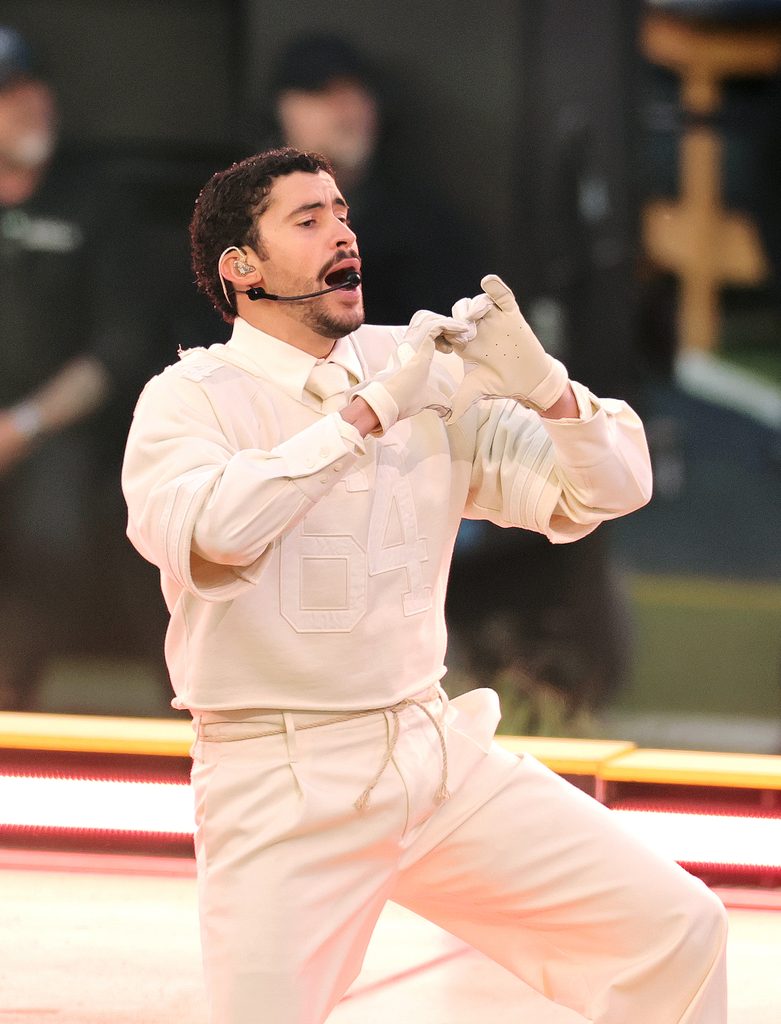
Bad Bunny talks about how he owes a lot to these predecessors, who broke into the global club scene with a sledgehammer so people around the world could start soundtracking their nights to Spanish. He staged a shoutout to early Puerto Rican reggaetón in his 2026 Superbowl performance by mixing Daddy Yankee, Tego Calderón, Don Omar, and Hector el Father as sweaty bodies gyrated around a white pickup.
But his songs are often fun, quirky, and vulnerable, ruminating on both pleasure and insecurities. We can call them self-examinations, even. He’s been making them for years: in “Si veo a tu mamá,” he wonders: “No sé por qué diablos me engaño / Diciendo que te olvidé cuando te extraño / Solo comparto memes, ya yo no escribo nada / Y no he borrao’ tu foto, solo la puse privada.” He rambles through more contradictory feelings in “Yonaguni,” where he allows that “quizás no sentiste lo que yo sentí / Pero aún te debo una noche en el suite para darte tabla / Mamí, habla.” What is sensuality, anyway, other than an unguarded question that requests reciprocation, a glimpse at what another person keeps hidden—even from themselves? Artifice around sex is fine, but the artifice eventually has to go away.
I’m not saying that Bad Bunny shies away from actual sex, of course. You don’t need me to remind you that listening to “WHERE SHE GOES” around other people is an act of fortitude. And yet even when it’s filthy, sex is mechanical—floating around on its own, it just isn’t sexy. Desire is what’s sexy, and desire can only exist in the context of sex (past, present, or future) that acknowledges a certain amount of vulnerability. Sure, “WHERE SHE GOES” has lines like “Mami, te vo’a dar / Hasta que te duela la popola como a Glo,” a reference to a 2005 underground reggaetón song by Glory that features aggressive female desire and never made it to international airwaves. But it also has lines like “Tal ve’ en ti quise encontrar / Lo que en otra perdí / Tu orgullo no me quiere hablar / Entonce’ vamo’ a competir, a ver.” Like with most things Bad Bunny, we get lots of things at once: there’s graphic sex, but also a healthy dose of self-interrogation.
And this multidimensionality allows us to find echoes of real interactions between real people in the otherwise too self-assured, gold-and-Maserati world of reggaetón/trap-inspired global chart-toppers. Bad Bunny’s track “EL CLúB” opens with what’s long been reggaetón’s flagship scene, pulled right from an early-2000s imaginary: “Las mujeres encima de mí, la hookah, las pastilla´ y un blunt / La que yo quiera dice que sí.” Then the pounding beat skids to a stop, and Bad Bunny wistfully wonders about his ex. What’s she doing, who’s she with? Is she over him, while he’s in a club thinking of her? Is he being—romantic? Lustful? Nostalgic? Remorseful? The answer: all of it.
With his intrusive transparency, Bad Bunny changed the game for sexuality in club music. In 2019, news broke that the reggaetón and trap superstar Ozuna had appeared in a gay pornographic video as a minor and Don Omar tweeted a derogatory term for gay people. “Homophobia at this point?” Bad Bunny tweeted back. “How embarrassing.” It marked a tidal shift: artists who ruled Latin club music in the aughts are used to being discursive and cultural flashpoints, but not passé. Yet it has occurred to many people, Bad Bunny included, that an unwavering appetite for masculine domination isn’t just unsavory or controversial, but also a little sad. And no one even has to use the phrase “toxic masculinity” to talk about it.
This all makes sense, right? Like most worthwhile things, sex and desire are slightly terrifying. Vulnerability ramps up the possibilities of pleasure—what’s sexier than allowing yourself to be seen? Lacan thought a lot about desire, and how it only exists once you speak it into being by revealing it to someone else. Intimacy, even and especially when it’s fleeting, is exhilarating because a person becomes momentarily transparent, and while a peacocking id might exist in all of us, it doesn’t exist alone.
It’s through this chaotic mash-up of swagger and uncertainty that Bad Bunny saves sex from the sad, unsexy fate it suffers in so many club bangers. “Titi Me Preguntó,” his club anthem for the ages, boasts about the number of women he’s been with and how good he makes them feel. He mixes self-lavished praise with breezy openings into his anxieties—the party keeps going as he sings about taking a selfie with women who’ve already forgotten all about him. In the song’s spacy, mixed-tempo bridge, he says, “Yo quisiera enamorarme / Pero no puedo,” and later, that he doesn’t trust any of them, or himself. At the same time, his lyrics feed on his own desire to be desired: “Tú tienes piquete, mami, yo también / Tú estás buena, yo estoy bueno también.” His partner takes equal ownership—women in Bad Bunny’s songs are sexy, inside and outside of the club, because they have wants that the singer wonders about and reacts to in connection with his own. For better or worse the singer, a version of Kundera’s epic womanizer, recognizes in sex the core dissimilarity that makes each person him or herself.
Sex in club music has often been reduced to cat-and-mouse metaphors, as in the international phenomenon “Despacito”: “Tú eres el imán y yo soy el metal / Me voy acercando y voy armando el plan.” Sometimes it’s distilled into a clinical description of the act, like the tragically on-the-nose “Noche de sexo”: “Decídete ya cuando será / Que tu boca tocara mi boca / So, dime ya que tú me das / Quiero sentirte, besarte, mi lengua pasarte.” But by exploring bodies and his own insecurities together, and expecting women to be just as involved, Bad Bunny brings sexiness to sex by recognizing its anarchy and ambiguity. It’s tied to what we want, what others want, and our fears about both. It shouldn’t be limiting, and in Bad Bunny, it isn’t. So when he waves his flag of “Que viva la putería,” it’s just as unstable as all the rest of his churning thoughts about sex. Ridiculous, yes, but we’ve been convinced along the way that what he’s saying is honest—which is to say, sexy.

