


With her first major acting gig in the United States, Shabana Azeez is learning American culture while captivating the country with her portrayal of Victoria Javadi in arguably the biggest show of 2025.
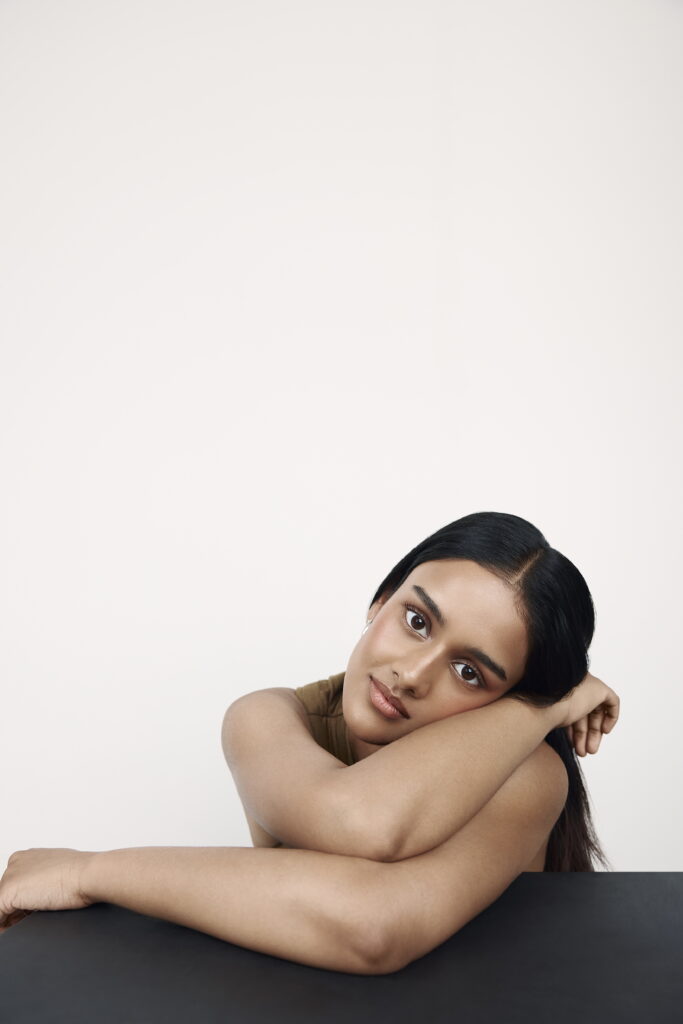
Shabana Azeez is having a moment. The 28-year-old Australian actress stars in HBO’s breakout hit medical drama The Pitt as Victoria Javadi, a 20-year-old prodigy who works in a fictional Pittsburgh emergency room alongside lead doctor Robby Robinivich, played by ER’s Noah Wylie. Javadi is The Pitt’s resident nepo baby—her mother works a few floors above her in the hospital as a surgeon. Azeez plays Javadi as a socially awkward nerd whose book smarts don’t always translate to patients’ bedsides. While Azeez has toiled in Australian film and TV, playing everything from a hipster waitress to a lesbian space princess, The Pitt is her breakout role in America.
Taking place over a day in the emergency room, The Pitt is 24 meets ER. The Pitt truly shines not only because of its stellar writing and compelling characters, but also because it illuminates the dysfunctional American health care system—from racial disparities in care to insurance company injustices.
Even if you don’t watch The Pitt, it’s hard to avoid the buzz surrounding the show, which follows a team of doctors and residents as they navigate everything from children sickened by eating weed gummies to rats running loose in the emergency room. The show has somehow made the underfunding and corporatization of hospitals must-watch TV. The Pitt won five Emmys (and was nominated for 13) in its first season and has led to ferocious debates over which Noah Wylie doctor portrayal is hotter—him as a baby-faced doctor in ER in the 1990s and early 2000s or as The Pitt’s 50-something Dr. Robby Robinavitch. While Wylie is top billed, The Pitt succeeds because of its ensemble cast, most of them women.
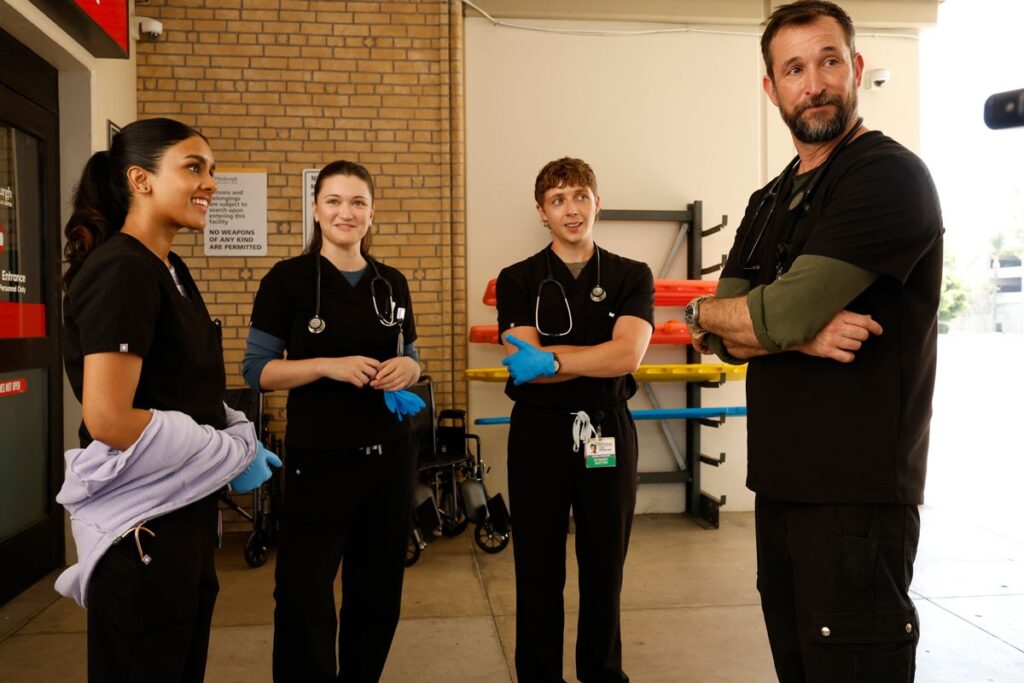
Shabana Azeez, Isa Briones, Gerran Howell, Noah Wyle in The Pitt
Though Azeez is not a household name yet, she’s more visible than she’s ever been. Her level of fame can be best summed up by her X account, “got recognized in the middle of a game of hide and seek in the park and it cost me my victory. Every silver lining has a cloud.”
BUST spoke to Azeez to find out how she’s handling the new-found success in the states, and how the Australian actress prepared for starring in one of the most zeitgeisty American shows in recent memory.
Born to Fijian and Indian parents, Shabana Azeez, who has long black silky hair and large expressive eyes, grew up in Adelaide, Australia. She started acting at 21 and took an office job to pay her bills. Her immigrant parents weren’t happy about her career choice as an actor. “They were mortified, and they still are,” she told a publication last year. But she praises her parents for giving her “a thick skin.” Azeez’s career pre-The Pitt spanned comedy and drama.
Azeez has played a studious medical student before, albeit in Metro Sexual (streaming on Amazon), a sitcom about an Australian sexual health clinic, which she says, “was a great intro to the world of medicine.” Yet, aside from their medical settings, the two shows are worlds away, she says. “The tone of The Pitt and Metro Sexual are so different, they’re apples and oranges. Sitcoms function so differently from dramas. I do think, though, that every job makes you grow as an artist, so they all build on each other in some way.”
Most recently Azeez starred in Australian film Birdeater, where she plays a soon-to-be-married woman accompanying her fiancé on his bachelor party in the Australian outback. (Birdeater premiered in the U.S. at SXSW last year and is available to stream on Amazon.) The horror film is an examination of toxic masculinity, manipulative relationships and psychological control mechanisms.
The pre-production for Birdeater was “heartbreaking” she says, as she delved into abusive relationships. “As much as Birdeater is about coercive control, it’s also about the kinds of people who see abuse and turn a blind eye. That’s what makes it such an uncomfortable watch. You really have to reckon with all the evil you’ve seen in your life and done nothing to stop,” she says.
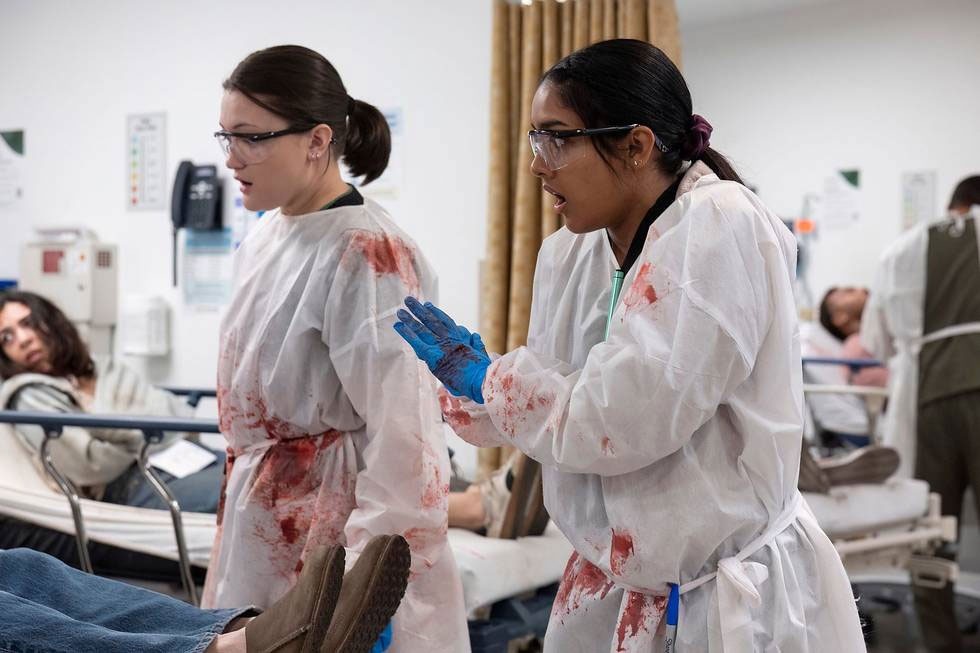
Isa Briones, Shabana Azeez in The Pitt
Since the film has been released, women have been approaching her and telling her their experiences with being victims of coercive control. “I hope Birdeater teaches people to hold their friends accountable for their actions,” she says.
Azeez is a proud feminist, and it shows in her work. “Equality and equity are so important, and the feminists of past days are the reason I can get a credit card in my own name, the reason I can file for divorce, the reason I can wear pants. I would never turn my nose up at that tradition,” she says.
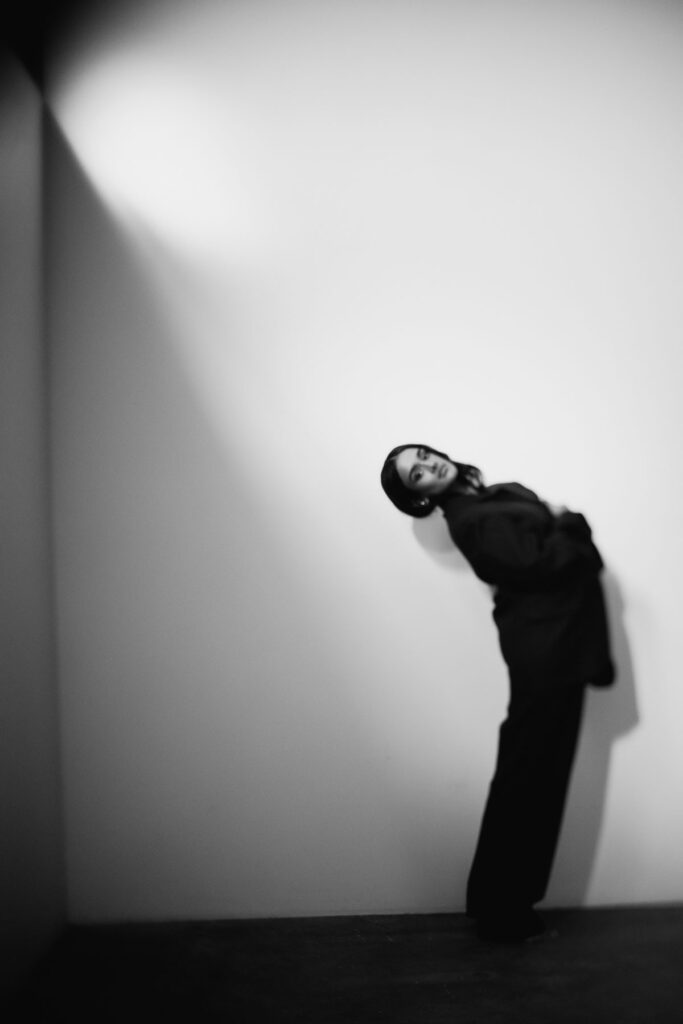
She is drawn to projects like Birdeater, with themes that can make people uncomfortable. “I’m so grateful to work with bold, brave storytellers who take their social responsibility seriously, make big moves, and take risks. I’m really drawn to that complexity,” she says. She’s fearless in her acting choices, picking roles whose queerness or quirkiness other actors might pass up. “If you only make art that is palatable to people in positions of power, you’re not doing the artist’s job,” she says. “I think all art is political. I don’t think you can make a film without a political message, whether you want to or not.”
Azeez was a long shot for a role in The Pitt. When she submitted her self-taped audition for the show, producers and directors told her they were only hiring actors from Los Angeles. When they asked her to take a Zoom call, it lasted all of nine minutes. Azeez was sure she wasn’t getting the role. “I cried after the Zoom because I thought that if they were going to break all the rules and start hiring actors from overseas…they would spend more time with me to make sure I was the right fit,” Azeez says. “[The audition] was so relaxed, and so short, that I was sure it was just a formality. I figured the other girl auditioning had done such a good job, they just had to finish this meeting with me so they could contact her agent.”
A week later she got a call from the producers: she’d gotten the role. Azeez was in the middle of working on Lesbian Space Princess, an Australian animated film where she played the titular lesbian space princess role. In the film, the princess is on an intergalactic mission to save her ex-girlfriend who is being held captive by lesbian-hating male incels depicted as talking white towels. As she pilots the ship to enter their planet, it shape-shifts into a penis that jizzes all over the princess’s spaceship. But Azeez’s character is undaunted. She simply turns on the windshield wipers and carries on to find her ex.
“The point of acting is to create empathy, so I want everyone to be able to have fun in Lesbian Space Princess. That’s the real goal of the film—we’re never punching down—things aren’t quite what they seem. The straight white maliens are undeniably charming, and no matter what your orientation, we want people to have a laugh and have fun while creating a safe, warm space for queer people. Hopefully, the film can start some conversations while also being a good laugh,” she says. The film also helped her craft her character on The Pitt. “Lesbian Space Princess prepared me for Victoria’s social ineptitude and isolation,” Azeez says.
These two controversial films were risks early in Azeez’s career, but risks she was willing to take. “With both Birdeater and Lesbian Space Princess, we knew the films would piss some people off and would mean the world to other people. And that’s okay! If there’s no price, there’s no payoff,” she says.
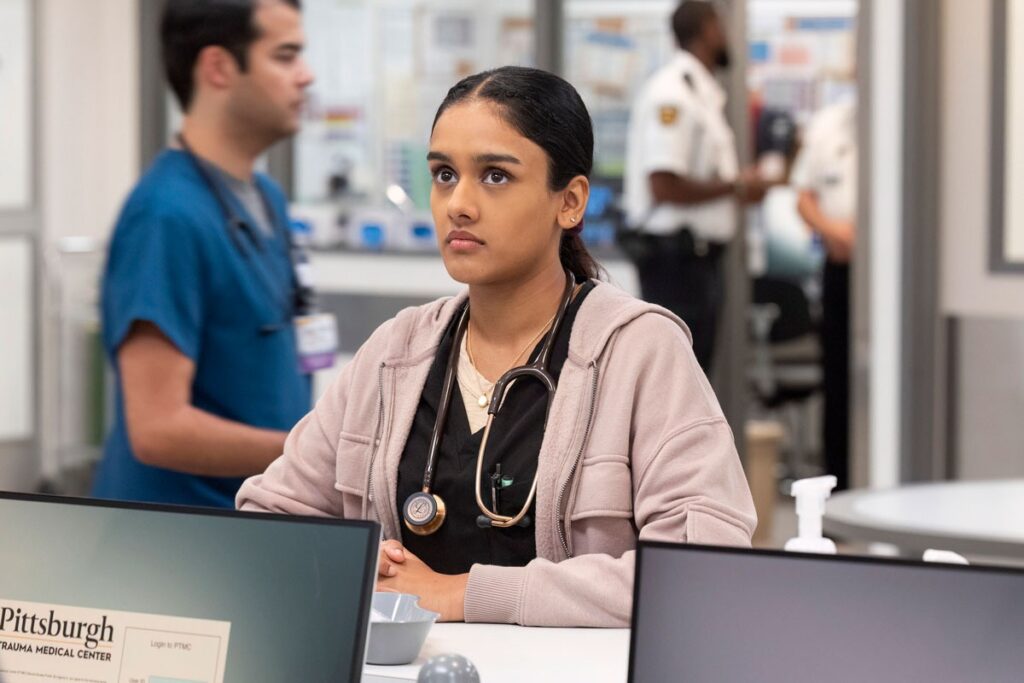
Shabana Azeez in The Pitt
Soon after wrapping Lesbian Space Princess, and a mere month after getting the call from producers that she had the role of third-year-medical school student Victoria Javadi, Azeez had to jump on a plane and fly to L.A. for The Pitt. “I basically went into shock,” she says. “Everybody from the production was being so chill, meanwhile, my life was completely turning on its head.”
Azeez got thrown into preparations immediately, with a two-week medical boot camp that was given to all the actors on The Pitt. The boot camp involved training on CPR, intubating, and doing ultrasounds on silicone pads filled with pockets of blood. “It was so fun, and such a lovely way to get to know the rest of the cast,” Azeez says.
She also did her own research, watching Wylie’s old show ER and various medical documentaries, reading books, and talking to medical professionals. “I really tried to get my head around the world of a teaching hospital…I interviewed doctors and med students and got an understanding of the culture of a med school—the dynamics, the kinds of kids that go into med, which types of students end up in which specialties—you can learn a lot from interviews that you can’t get from a textbook,” she says.
It wasn’t just medicine that she wanted to learn about, but also American culture. “I think an ensemble show requires everybody to do research beyond the setting of the show (in our case, a hospital) or we all end up bringing the same energy to the scenes,” she says. Because she was playing the main Gen Z-er on the show, she wanted to get the details right. “I really wanted to represent young women. I watched a lot of glossy American teen shows, spent time on TikTok, and listened to Olivia Rodrigo,” she says. “I read up on loneliness and the perfect migrant trope and what it’s like to be too smart too young. It all helps create distinct identities and energies in a scene. I want you to be able to feel that Victoria’s in the room without me even having to speak.”
Azeez also studied the darker aspects of the U.S., particularly its gun culture. “I also did a lot of research on the U.S., cultural specificities, and gun violence. Mass shootings specifically (is this a spoiler?!), but then also school shooter drills and the PTSD that comes with that,” she says.
Despite being mostly filmed in L.A., the show stays true to Pittsburgh (speaking as someone who was born there). One episode focuses on a patient who designed sets for the TV show Mr. Rogers, created by Pittsburgh-native Fred Rogers. Doctors and residents nosh on Pittsburgh’s famous french-fry-filled Primanti Brothers sandwiches and discuss ordering the salmon from Wholey’s Market. Iconic Pittsburgh neighborhoods like Squirrel Hill and Shadyside are also mentioned. (I’m still waiting for the mention of Prantl’s burnt almond torte.)
Victoria’s character is almost a surrogate for the audience with her innocence and squeamishness. We watch her start the first day timidly, fainting at the sight of a mangled bloody foot, and being christened with the nickname “Crash” by fourth-year medical student Trinity Santos (who keeps calling Victoria “Crash” even though she explicitly tells her not to). Victoria’s clearly brilliant (she enrolled at the University of Pittsburgh at age 13), but it’s book smarts and not bedside manner that she excels in. While her character Victoria is socially awkward, she has enough confidence to ask out her hunky nurse co-worker Matteo (Jalen Thomas Brooks) in front of a patient.
Victoria doesn’t want her co-workers to know that her mother works at the hospital, but when her mom comes down to assist with a surgery and chastises Victoria for not knowing about an appendicitis treatment, her co-workers figure it out.
Ironically, Azeez, who is not a nepo baby, is playing one on a show full of actual nepo babies. Taylor Dearden who plays neurodivergent resident Dr. Melissa “Mel” King, is actor Bryan Cranston’s daughter; Fiona Dourif who plays Dr. Cassie McKay got her start in Chucky movies (her dad played Chucky); and Isa Briones first started acting alongside her father Jon Briones in Picard.
Azeez has her own take on nepo babies, one that’s a bit more forgiving than anti-nepo baby discourse usually is. “Privilege is not necessarily the absence of hard work; it can be the opportunity to do hard work. So when people get called a nepo baby, they think people are calling them lazy and undeserving, but that’s so not the case,” she says.
Azeez studied up on nepo babies to get a sense of her character, and she thinks it’s important to show nepo babies in a hospital context. “I spent a lot of time in pre-production braining my way through how I wanted to tackle it. I watched a lot of Hollywood nepo babies speak on it and figured out whose rhetoric was aligned with what I wanted to say. Maya Hawke and Alison Williams came out on top for me—they’re so well-spoken about it,” she says.
Azeez’s character comes from privilege, but she’s also hamstrung by it, and it’s not like she’s coasted; it’s the opposite, Azeez argues. “Victoria works extremely hard—that’s how she’s a third-year medical student at 20—and she has challenges in her life as all humans do, but she doesn’t have the same struggles that [other residents] Whitaker, Samira, and Mel have. She’s under a lot of pressure from her parents, and being compared to them is painful and paralyzing, but that doesn’t negate the fact that she doesn’t have to live in an abandoned wing of the hospital like Whitaker. Every circumstance has its struggles, and nepotism is one of the circumstances of her life,” she says. “I hope she navigates it imperfectly over the next few seasons and we get to see her learn how to juggle it all with grace.”
Why is The Pitt resonating so well with audiences? Azeez has a theory. “I think audiences are really craving no-bullshit TV right now. They just want to see themselves and their communities reflected back. There’s also something about how much all our characters are trying to help people. In a time when empathy is being vilified, it’s so hopeful and refreshing to see people care.”
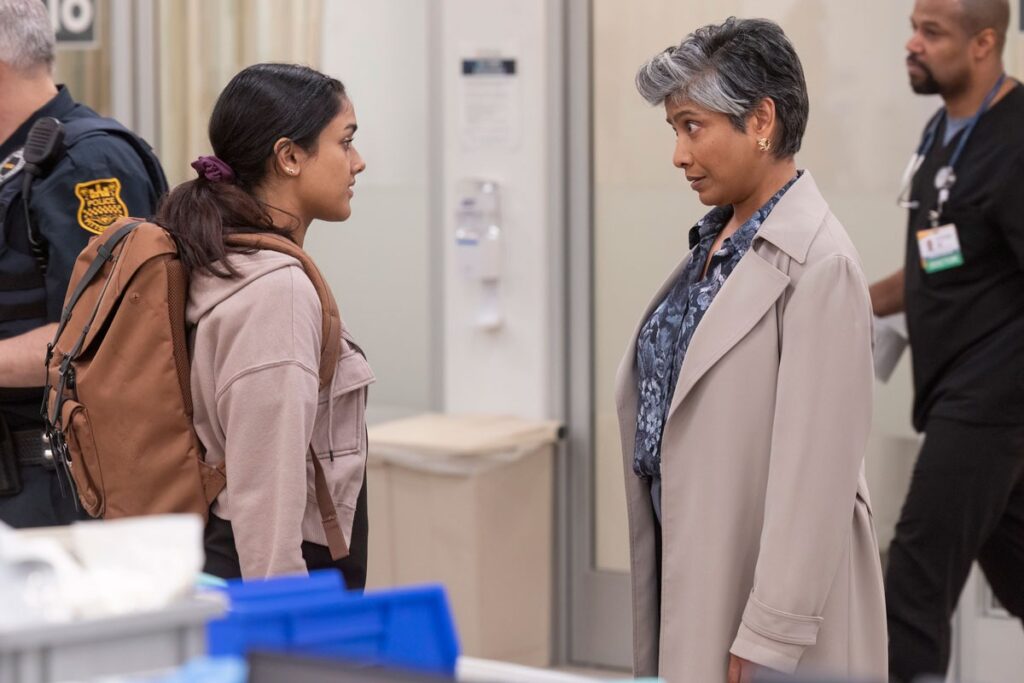
Shabana Azeez, Deepti Gupta in The Pitt
Thanks to The Pitt’s Emmy wins, more people are receiving this message, which thrills Azeez. “I’m so grateful that the Emmys recognized the show, because our wins have already had a massive impact for us. More people are watching the show than ever!” she says. She hopes the show can create real change. “I hope that in a few years it starts having an impact in hospitals and we can stop violence against healthcare workers and make real-world positive change. That would be incredible.”
Though she’s now in the mainstream, Azeez isn’t planning on taking the safe route in future projects. “Moving forward, I want to play characters you hate in films you love, and characters you love in films that make you want to tear your hair out. I want to make people feel things: anger, sadness, embarrassment, and affection. In my work so far, I’ve been so lucky to get to see the impact of meaningful stories. I hope my next project makes the world a better place.”
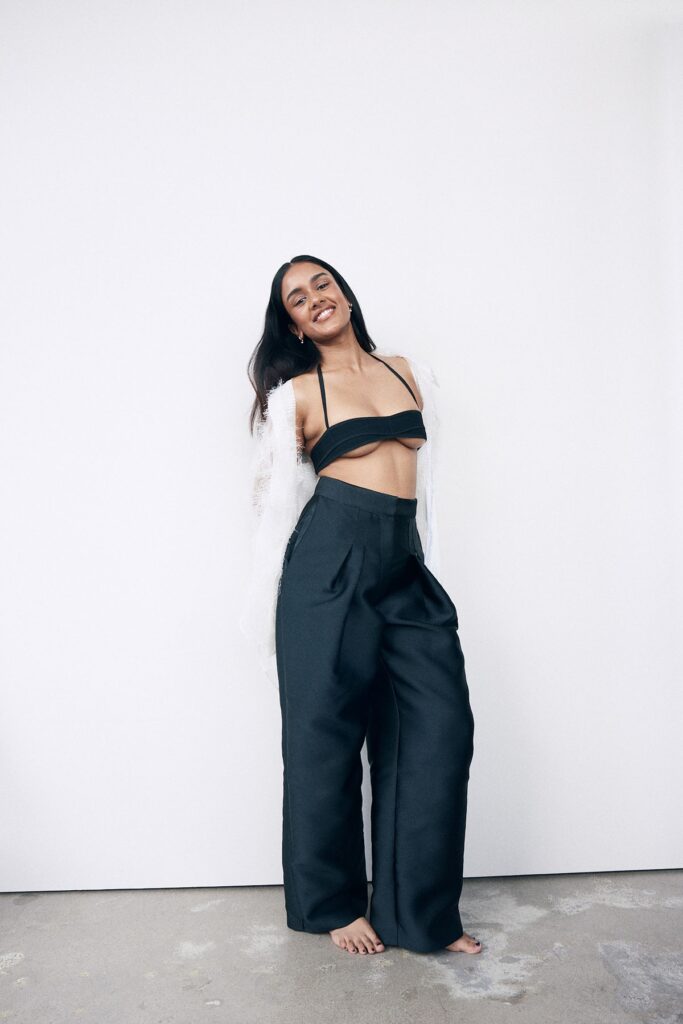
All Studio Shots:
Photo: Jonathan Vdk @Jvdkphoto
Styling: Ava Viscariello @Avav.Isc
Hmu: Adele Shearwin @Del.Sfx

