


For lovers of all things macabre, BUST has found your next favorite artist. Meet Mary Kate Hardy, a mixed-media creator and National College of Art and Design graduate with a B.A. in fine art media. Hardy’s work explores haunting themes and visceral expression through the human body. BUST sat down with the artist to discuss her inspirations—and what led her to embrace such shadowy subject matter in her art. When discussing her work, Hardy stated, “I think the macabre found me. From a young age, fear and anxiety has always been something that I have quietly dealt with. At the beginning of my art career, I instinctively and unconsciously gravitated toward uncanny themes. Only later, when I became aware that not everyone suffered from frequent feelings of intense anxiety, did these themes become a deliberate practice in my art. For the last five years my work has explored themes based around fear and anxiety using the human form as the subject. It attempts to showcase the deeper emotional torment of when one is at odds with oneself. I aim to portray the silent emotional suffering common in humanity and create connections to help encourage conversation among those who recognize the struggle. This often results in uncanny and macabre work.”
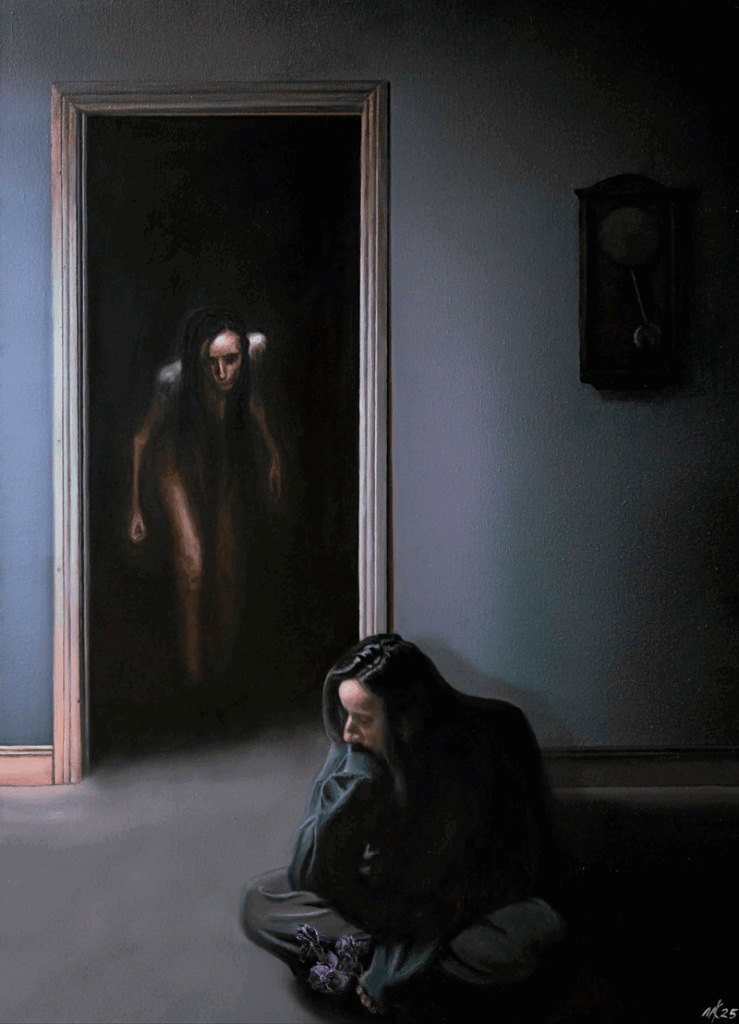
Working with a variety of mediums is core to Hardy’s artistic vision. As she states, she is a shapeshifter of all surfaces and textures. When discussing her work across different surfaces, textures, and canvases—something that is characteristic to her art practice—she explained, “I have used many mediums throughout my art career, including sculpture, sound, video, installation, and painting. There were years of experimentation. For a long time I was also drawn to using taxidermy as a medium but I ultimately decided that the animals were not mine to manipulate. In college I studied fine art media, where my practice mostly involved installations. For my final-year project I immersed an audience in an environment designed to trigger their raw, visceral responses; specifically fear. I built a room and filled it with fog. Centered within the room was a single light source. It invited participants to engage with their newly created artificial anxiety. The walls and floor were uneven, the fog was dense, and the sounds were high-pitched, uneven tones, which aimed to engage the participants’ innate response to animal distress calls. The work was successful because it consumed all of the senses. In my current practice I no longer create installations and instead focus on creating visual narratives with oil paint. There are many reasons for this, such as cost, time, and ease of execution, but primarily it is because I am a visual person. It is easier for me to process ideas through imagery. I also love the painting process, the different possibilities and happy accidents it can produce.”
Hardy has truly become a master of her craft, as well as a master of learning how to adapt in a crisis. After Hardy lost her job during the pandemic, she started experimenting with another new medium, special-effects makeup, an experiment that ended up illuminating new understandings of her art. Regarding this time in her life, she shared, “[During the pandemic] I lost my job and turned to special-effects makeup as a distraction. It was less serious so I was less precious about the outcome. It was purely a creative and experimental outlet. Because I was applying SFX makeup daily, I found that I was always studying my face. This unexpectedly helped me further develop my skills in portraiture. When you’re engaging so much with your own face you begin to look at form and anatomy. It gave me an understanding of the facial structure and how our features engage with light. This prompted me to buy books, watch videos, and study other artists to actively improve my painting. When I finally moved away from SFX makeup I took all of that information to the canvas.”
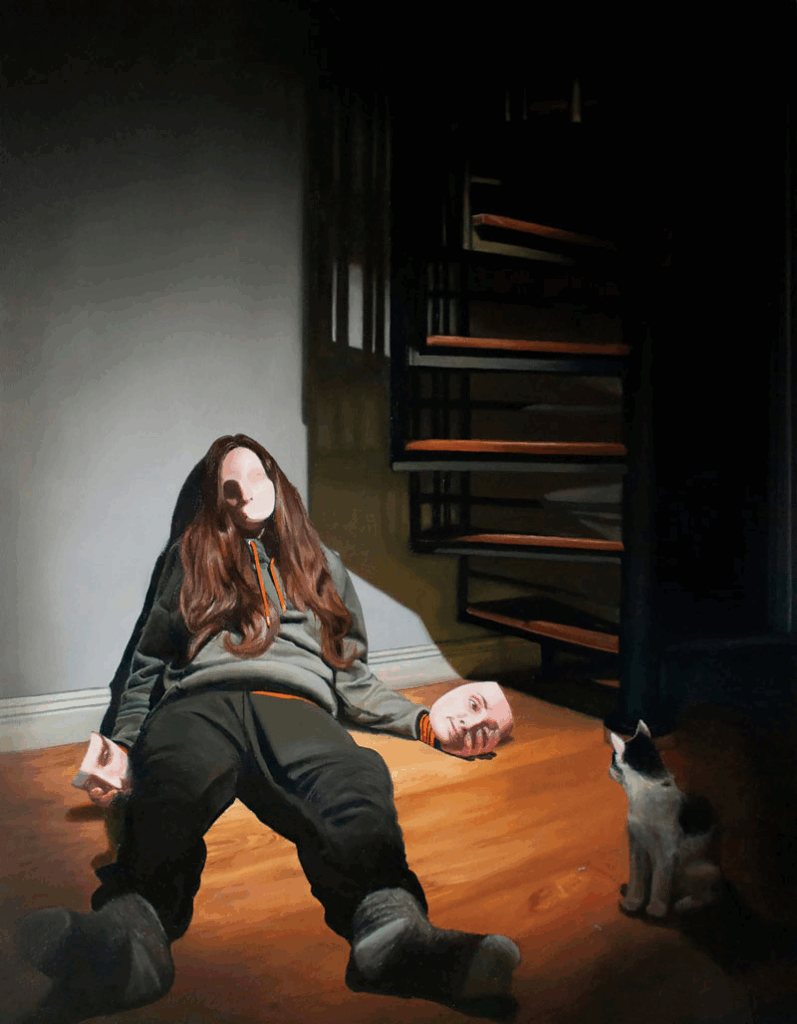
This period in Hardy’s artistic career is just one small example of how her art practice has evolved throughout the years. A key catalyst for her continuing evolution is growing confidence. She states, “Change came primarily from time. Over the years I have tried out many different methods of painting while figuring out what I wanted to say. This allowed me to home in on the things I liked and eliminate methods from my practice that didn’t work for me. When I began painting, I started with impressionistic landscapes and seascapes using palette knives and thick layers of acrylic paint. Later I moved on to learning how to paint people. I did impressionistic portraits first, then experimented with abstract figures and oil paint. In recent years my work has become a neat and realistic style with a cohesive and clear visual narrative, something which I think has developed from a growing sense of confidence with age and so much experimentation.”
Currently, Hardy’s paintings center very dark, layered human emotions, such as grief, longing, and isolation—emotions that seemingly stem from a very personal place. While Hardy has taken commissions in the past, she remains vigilant in her commitment to authenticity, even when she creates pieces for other people. “I used to do a lot of commissioned portraits of families, children, and pets. I know now that it is a sure way to make you feel like a terrible painter,” discloses Hardy. “Meeting someone else’s expectations is tough; even if they trust your vision, you still have to meet your own expectations and that can be harder. Back then these commissions never veered into my personal space. Most came before I started employing such heavy themes in my work. Recently I have received requests from people asking me to replicate my paintings but with them recast as the subject. But the work I create now is personally revealing and I would not like to dilute my true intentions even if it makes sense financially. I do my best not to take commissions anymore. I want to create authentic work. When people engage, understand, and enjoy it, it’s deeply fulfilling. It’s an incredible sense of freedom.”
The best way BUST readers can continue to support and follow Hardy’s work is through @marykatehardy on Instagram, YouTube, and TikTok. Her original paintings and prints are also available to purchase at marykatehardy.ie.
All Images Courtesy Of Mary Kate Hardy

