


For generations, women have been taught to keep certain parts of their bodies private. Periods, sex, and reproductive health have slowly become more open topics of conversation, but when it comes to labia and the appearance of our genitals, there’s still plenty of mystery, misinformation, and shame. Now, as women turn to online communities and social media to talk more candidly about their bodies, another conversation is gaining visibility: labiaplasty.
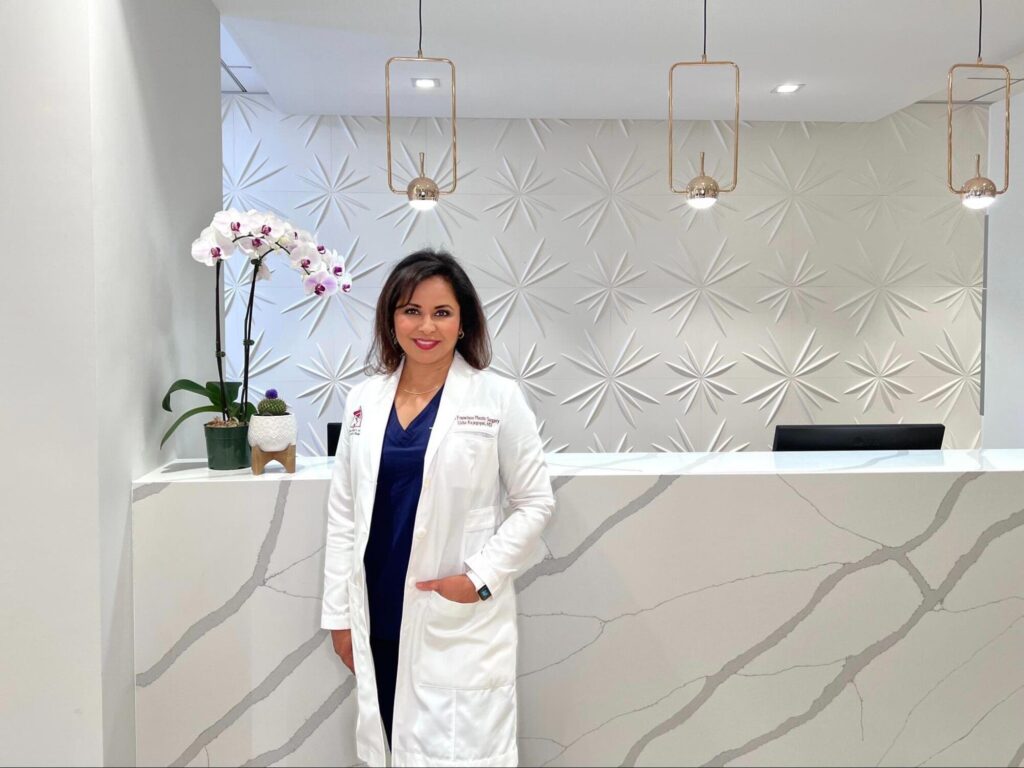
Dr. Usha Rajagopal, a board-certified plastic surgeon and medical director of the San Francisco Plastic Surgery & Laser Center, has performed labiaplasty since 1999. She also leads the V Suite, the practice’s dedicated center for vaginal rejuvenation, which offers treatments focused on women’s intimate health and wellness. Over more than two decades in practice, she has witnessed a significant shift in how openly women discuss these concerns.
“When I began performing labiaplasty in 1999, there was virtually no conversation around vulvar or vaginal health,” Rajagopal says. “For more than a decade, these topics remained largely taboo, with very little awareness or open discussion.”
Today, women have far more access to information and opportunities to connect with others who share their experiences. Online forums, social media, and personal stories can help women realize that questions they may have felt embarrassed to ask are more common than they thought. Rajagopal believes this access to information has been one of the biggest changes, giving women more tools to understand their bodies and advocate for their health.
Of course, the internet is a mixed bag. Alongside helpful information, social media can amplify unrealistic beauty standards and make it easy to compare our bodies with carefully curated images. When it comes to labia, that comparison can leave women wondering whether their anatomy is normal—or whether it should look different.
So, What Is Normal?
The short answer: there’s a wide range of normal. Labia vary in size, shape, color, and appearance, and having larger or more prominent labia does not automatically mean anything is wrong.
Rajagopal compares natural anatomical variation to differences in height. A woman who is five feet tall and a woman who is six feet tall can both be completely normal. The same principle applies to labia: there is no single appearance that every woman should have.
Still, many people grow up with little education about what genitals actually look like across a diverse population. Without that context, media portrayals and comparisons with other women can influence what someone believes their body is supposed to look like.
Rajagopal says patients may compare themselves with siblings, friends, or women they have seen in locker rooms. When women consider labiaplasty for aesthetic reasons, she says, many describe wanting their labia to look “prettier” or “neat and tucked in.”
That raises a bigger cultural question: How much of our idea of the “ideal” body comes from personal preference, and how much comes from expectations we’ve absorbed over time?
There isn’t one answer for everyone. But knowing that natural variation is normal can help women make decisions based on their own needs rather than the assumption that their bodies must fit a particular standard.
More Than a Cosmetic Conversation
Labiaplasty is often framed as a purely cosmetic procedure, but Rajagopal says patients may seek it for both aesthetic and functional reasons.
Some women experience pinching, tugging, or chafing, particularly when wearing tight clothing such as jeans or yoga pants. Others describe discomfort in swimsuits or pinching during intercourse. For some patients, appearance is the primary concern; for others, physical discomfort plays a significant role.
Having larger labia does not automatically indicate a medical problem, and not everyone who feels self-conscious needs or wants surgery. But women experiencing persistent discomfort should be able to discuss their symptoms with a qualified healthcare professional without feeling embarrassed or dismissed.
The conversation also complicates the way we talk about body positivity. Women should not feel pressured to change their anatomy to meet someone else’s beauty standards. At the same time, they should be able to explore their options without being judged for considering a procedure.
For women who are interested in labiaplasty, Rajagopal recommends seeking a plastic surgeon or gynecologist who performs the procedure regularly, rather than someone who offers it only occasionally. Understanding the potential benefits, risks, and recovery process is an important part of making an informed decision.
Breaking the Silence
The conversation around women’s bodies has changed, but intimate health still deserves more attention. Rajagopal hopes discussions about labiaplasty will eventually feel as commonplace as conversations about breast augmentation, injectables, and facelifts.
She also emphasizes that vaginal health is about more than appearance. Hormonal changes, particularly during the late 30s, 40s, and 50s, can affect vaginal and vulvar health. Women experiencing symptoms should feel comfortable discussing them with a gynecologist or primary care provider and learning about appropriate treatment options.
Ultimately, opening up the conversation isn’t about telling women how their bodies should look—or suggesting that surgery is the answer to insecurity. It’s about making reliable information easier to access, helping women understand what’s normal, and creating space for honest questions without shame.
Because women deserve to feel informed about their bodies, comfortable seeking care, and free to make personal decisions without pressure. And if we’re finally learning to talk openly about the parts of ourselves we were once taught to hide, that conversation is worth continuing.

