


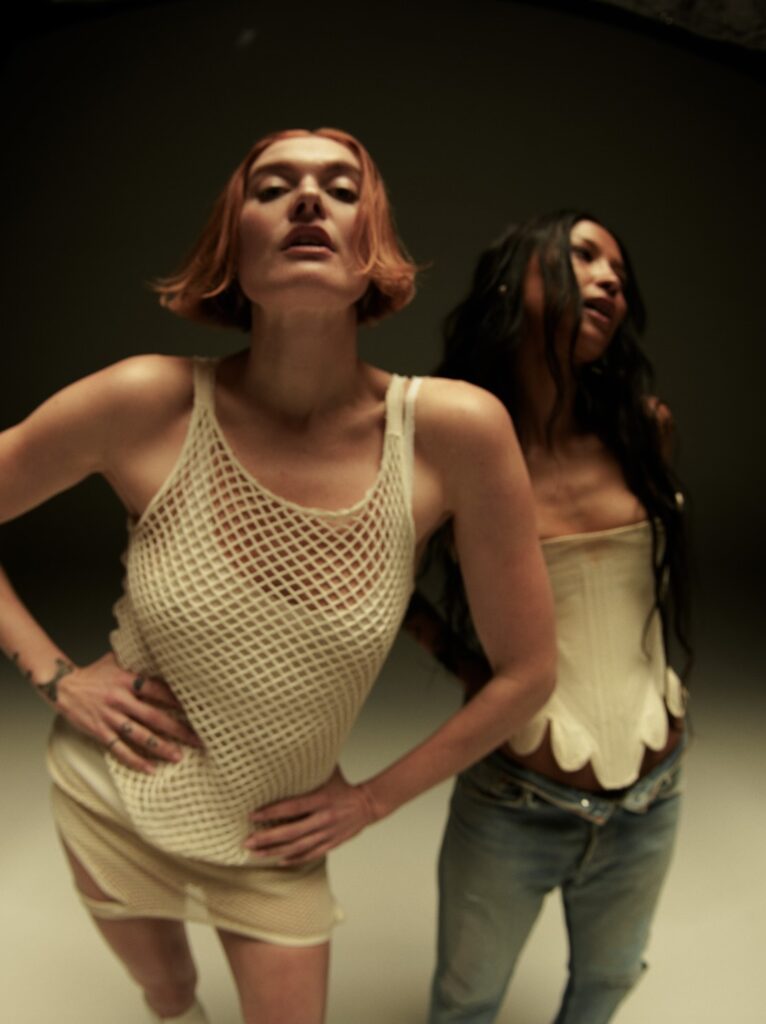
Almost two decades into working together, Icona Pop’s Caroline Hjelt and Aino Jawo had to stop and ask a question that once felt instinctive: who are we now? Speaking with BUST ahead of the release of their fourth album, Ritual, the duo reflected on burnout, motherhood, friendship, and choosing each other again.
Not just as a band, but as individuals. After more than a decade of constant motion — touring, recording, festivals, film and TV appearances, all while building a global identity — the answer wasn’t as obvious as it used to be. There was creative burnout, motherhood, relocating from Stockholm to LA and back again, and the quieter, more disorienting work of figuring out what came next when the momentum slows down.
“We went through a lot of changes and we worked through a lot of stuff. And we joked about it, but it’s also true,” Hjelt tells BUST. “We chose each other again.”
Their fourth studio album Ritual, out August 14, arrives out of that choice. It is framed as a new, more raw era for the duo, but it’s also something more grounded. Ritual is a record shaped by pause, reflection, and the slow process of returning, not just to each other, but to themselves.
For a duo whose breakout moment came with the synthy, generation-defining energy of “I Love It”, the idea of slowing down might seem almost contradictory. But Ritual doesn’t abandon that energy. Instead, it reframes it, merging their familiar upbeat production with their most emotional songwriting yet.
Finding their way back to each other
For the first time in their career, Caroline Hjelt and Aino Jawo found themselves in completely different places. “I’d been burnt out, two kids, so much emotional stuff going on,” Jawo explains, describing a period where everything that once felt stable began to shift. “It felt like trying to rediscover a new you and not go back to old habits. Having children, you change. You kind of let go of your ego.”
At the same time, the question of identity, something that had once come easily, became harder to answer for Jawo and Hjelt. “I just felt like I needed the time to figure stuff out and to find a way back to me. Just asking yourself like, wait, who am I? What do I want? What do I like?” Hjelt contemplates. “Sometimes in your life, those questions are easy to answer. Then sometimes, I have no idea. I need to find my way back, be curious and do the work.”
It’s a feeling that sits in contrast to the early years of Icona Pop, when everything moved quickly and instinctively for the pair. Back then, their sense of self (individually and together) was something they didn’t have to interrogate too closely. Now, it requires time, space and a willingness to sit with uncertainty. Moving back to Sweden during the pandemic forced a kind of stillness and need for reconnection that had been somewhat absent in recent years.
“You end up in your childhood room and you’re over 30 years old. It’s crazy,” Jawo says. “But it’s cool, though. Either you do the work or you don’t, but I just feel like I’m so proud of us for doing that. We were able to do this album and through it allow ourselves to take some space to figure stuff out. I don’t take that for granted.”
Hjelt continues where Jawo left off, “I think it’s cool that our friendship is so strong and that we’ve been a band for such a long time, you know, it would have been different if we started our band yesterday and then went through [these changes].”
There’s something almost bittersweet about that image. Artists who had spent years commanding global stages suddenly back in the spaces where they first formed their senses of self. But for them, that became a point of reflection rather than stagnation.
“And a lot of emotional stuff came up as well. We developed a lot when it comes to being an artist and living a certain way, like travelling constantly, running a business, things always happening,” they explain. “This was the first time we had time to just sit down and let all these years land.”
Rebuilding the band
What followed wasn’t a dramatic breakup or reunion. Icona Pop never stopped working. But the way that they worked and the way that they understood each other changed.
“For the first time, we were in two completely different places in our lives,” they say. In the early days, their process was defined by intensity. “We felt like it wasn’t a session if you weren’t in there for 24 hours,” they recall.
Today, that mindset feels almost unrecognisable. “Now it’s like, you know what, I’ll do a better job if I’m there for three hours.” Motherhood, in particular, reshaped their priorities in ways that extended beyond scheduling.
“When you have a child… suddenly, it’s not about you,” they say. “And having kids, it also makes you appreciate the time in the studio. When we’re there, we’re very effective and we appreciate the time. We’re like, oh, my God, it’s going to be so fun to write a song today!”
The version of themselves that had once been wrapped up in their work had to make space for something entirely new. And in doing so, it disrupted the sense of continuity that had defined their career up to that point.
But rather than trying to return to who they were before, they approached the process differently.
“I don’t feel like it’s a new identity,” Hjelt says. “I just needed time to figure stuff out and find my way back to me.”
Ritual isn’t about reinvention in the traditional pop sense, there’s no dramatic shedding of one persona for another. It’s about understanding how the past and present versions of themselves can coexist. And crucially, it’s about choosing to do that together.
Letting the emotions come first
That process of self-reconnection shaped the album at its core. “We’d been crying a lot in the studio,” they admit. For a duo known for euphoric, high-energy music, it marks a shift. Where earlier work often masked heartbreak in synth-driven production, Ritual allows those emotions to sit more openly.
“If it is a sad song, let it be sad.” That approach is most evident in tracks like “Hurt”, where the lyrics are stripped back and direct: “Although you hurt me / there’s still a heart in my chest / although you hurt me / everything comes to an end.”
There’s no attempt to disguise the emotional core of the song. Jawo says, “I think we are pretty good with disguising heartbreak songs in happy pop melodies. But this time, some songs on the album are really raw.”
“It’s like a release,” Hjelt chimes in. “I think that was liberating and scary.”
The writing process followed that same logic. The more difficult material came first, almost involuntarily. “It was almost like it needed to get out of our system before the other stuff could come.”
In talking more about the songwriting process for Ritual, they reflect; “I think we both thought that we were going to go in and write more of an uptempo thing. But then some songs needed to come out first. And then the dancier and poppier songs could come. But it is like writing a diary. I mean, it’s really therapeutic to write in that way.”
Only after working through those emotions did the more recognisably Icona Pop sound begin to re-emerge. Tracks like “Dance To This” reconnect with the gritty, scrappy energy of their early sound.
“Of course, we wanted to do something new, do something fresh. But I think we were also in a phase where we were appreciating and kind of reminiscing. Looking back at [that] time in music where it was kind of gritty and French electro and indie.” Hjelt reflects.
While they took this time to rethink their sound and processes, it was also a chance to think about how far their own relationship has come. “That’s where we come from, where we met. That’s who we are at our core. And so I feel like that’s when we started saying we should do a song like that. That’s “Dance to This.””
Some ideas have been sitting with them for years, waiting for the right moment. “We wrote the chorus in 2009 and re-wrote it. We took that chorus and used it on a song on this album,” they say. “It’s been like 16 years in the making. It’s funny how two songs can become one. And now it feels so nice. Like, it’s always been there.”
The dancefloor, then and now
For Icona Pop, the best thing about music is the live experience. Festival circuits, nightclubs, the crowds. For Hjelt and Jawo, the dancefloor has always been more than a site of celebration. It’s where they first learned who they were.
“For us, it was everything. It wasn’t about drinking. It was about dancing and handling your problems.” That space allowed for a kind of openness that’s harder to replicate elsewhere. It wasn’t unusual to move between extremes–emotional one moment, euphoric the next.
“We were literally standing on the dancefloor crying. We were standing on the dance floor super happy. We were making love on the dance floor. Everything happened on the dance floor.”
There was also a sense of freedom in how people occupied that space. “You could just go there in your jeans or dressed up to the teeth… whoever you wanted to be.”
That version of club culture, messy, communal and largely undocumented, feels increasingly distant. “We didn’t have phones. People didn’t try to reach us in the middle of the night. And no one was filming you. If you messed up, it was okay. No one’s going to tell.”
Today, the presence of phones and the permanence of being seen has subtly changed how people move through those environments. The possibility of being recorded, judged, or watched creates a new kind of self-consciousness.
“Now it feels like people are so scared that they’re going to go out and maybe mess up, or maybe their boss will see. And it’s going to be there forever,” they say. “It’s just the freedom, how important it is to just go and have fun. Listen to good music, hang out with friends. Wherever you are, whatever you need. If you’re going through something hard that you’re dealing with, perfect, or if you’re just happy, great!”
It’s not that those spaces have disappeared entirely. But the conditions around them have shifted. And for a duo whose identity was shaped within that earlier version of club culture, that change is noticeable.
At the same time, they don’t see it as entirely lost.
“I think people just want to feel and they want to connect. I feel like real life connections and getting together is super important. Everybody wants to do that, but it’s just about where.”
That desire for connection and shared experience is still there. Today, it just takes different forms and it needs different spaces. In that sense, Ritual becomes a way of recreating that feeling, even if the context has changed.
Even after more than a decade, Icona Pop still speak about “I Love It” with genuine affection rather than exhaustion. They laugh when I ask whether there’s ever pressure tied to performing songs so closely associated with a specific moment in pop culture.
“People would be super disappointed if we didn’t play it, I totally understand that,” they admit. “But the energy when we play it now, it doesn’t even feel like our song anymore. It’s everyone’s song.”
Rather than feeling trapped by the success of the track, they seem grateful for the longevity it’s taken on over the years. “I totally get if artists would get tired of playing [the same songs], but we just feel super blessed and happy about it. Also, If that can spark something for someone, you know a memory or a feeling, why wouldn’t we give that to them?”
Jawo adds, “Of course, right after “I Love It”, it was a pressure to follow up with something similar. But now that song is going to survive us all.”
The pair are especially amused by the age range of the audiences who still connect with it. “All the kids from my son’s preschool know that song. But also my husband’s grandma knows it. The span is so big.”

Rituals, routines, and survival
The core idea of ritual runs throughout the album. The importance of being grounded in small, repeatable actions, especially in difficult times, is clearly crucial for the pair.
“I know for a fact that going out in nature for both of us is super essential. Going into the woods and listening to birds and just touching nature. I would say that’s number one.” Jawo remarks.
Hjelt agrees and adds, “And moving your body in some way. It can be dancing in your kitchen or it can be out running, whatever you like. But I feel like movement is so important to not just get stuck. Rest is very important, but then maybe you do like a super slow flow [yoga] or something.”
They also acknowledge the importance of smaller everyday routines for your mental health, “brushing your teeth, taking a shower, making the bed.” They’re simple things, but that’s the point. When everything else feels unstable, those small acts provide a sense of normality.
Alongside those mundane rituals, they advocate for turning to the arts and culture in times of uncertainty, “Also listen to good music, look at beautiful art. That sounds so silly, but the world is kind of crazy. I feel like if you take your time to listen or look at something, it can be a beautiful painting or it can be a flower, you pause for a second. You can think about something other than what’s bothering you.”
Across Ritual, that idea repeats in different forms. Survival isn’t always dramatic. It’s not always about big, visible transformations. Sometimes, it’s about maintaining momentum in quieter ways.
“This is my ritual, yeah I do it to survive.” The line captures the album’s underlying logic: movement as a form of endurance.
Still choosing each other
Despite everything, the foundation of Icona Pop remains the strength of their relationship.
“It definitely feels like we’re stronger, we’re in a very good place. And I feel like we’ve been through a lot, the best times and the hardest times, she’s going to be family forever. There’s nothing that’s going to change that.” Hjelt asserts. “But it’s also cool to see us grow together. When it comes to not just the fun parts, more like how we work and how we do that now with kids and everything.”
Jawo agrees, adding “100%. Yeah, but also, I feel like we’re taking care of our relationship. Because now we also have the time to sit down and discuss things. And we’re so not alike. We’re very, very different.”
Hjelt finishes for Jawo, “Yeah. But in some beautiful way that works really well. So I would say that our relationship is in a very nice place.” When I point out how naturally they complement each other, Hjelt laughs. “We’re like an old couple, finishing each other’s sentences.” Jawo immediately jumps in: “17 years together!”
Throughout our conversation, the pair slip in and out of each other’s thoughts with ease, reflecting on burnout, creative freedom, becoming parents and change with the kind of familiarity that can only come from years of shared history.
That bond hasn’t stayed static. It’s evolved alongside them, shaped by the same pressures and changes that informed the album itself.
The way they mention taking care of their relationship now suggests a rare awareness. That longevity, especially in a creative partnership, isn’t automatic. It requires attention, intention, and, at times, a conscious effort.
Maybe that’s why Ritual feels more like a natural continuation than a comeback.
Photos by Teitur Ardal

