


My Mom Jayne is a new documentary that reexamines the life and legacy of 1950’s Hollywood blonde Jayne Mansfield, as told by her daughter, Law & Order’s Mariska Hargitay (check out our cover interview with Hargitay here).
Mariska Hargitay was just three years old when her mother Jayne was killed in a car crash on the way to an appearance in New Orleans. Mariska and her two siblings were in the back seat and survived the crash. The driver, Jayne, and Jayne’s lawyer and partner, seated in the front, were all killed. Jayne was 34.
Having no memories of her mother, Mariska interviews her siblings, her mother’s peers, and sifts through the family storage unit to understand her mother’s complex life.
What she finds is nothing short of extraordinary…
Known today for her curvy figure, platinum hair, and breathy-voiced persona, Jayne Mansfield is perhaps the most successful actress that came following an interesting trend in Hollywood: the Marilyn Monroe copycat.
You’ve probably seen the famous photograph of Italian actress Sophia Loren seated at a table next to Mansfield, eyeing Jayne’s ample bosom looking as if it’s about to leap from her dress. This is the Marilyn effect personified.
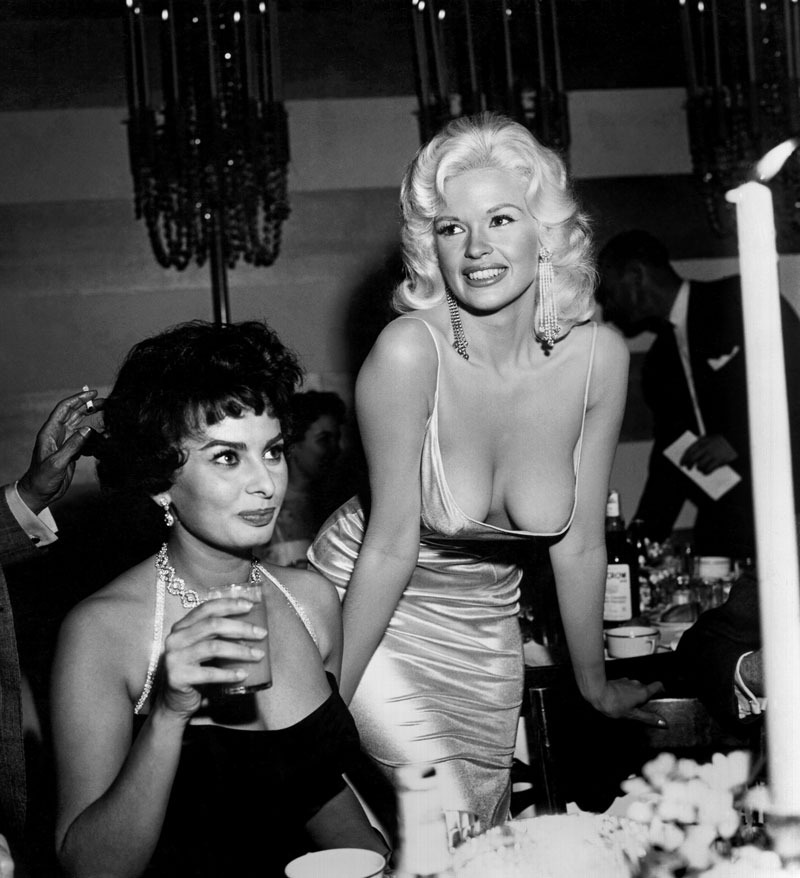
Sophia and Jayne Courtesy Of Michael Ochs Archives / Stringer_GettyImages-73908236
The Marilyn Effect
Hollywood likes to repeat itself ad nauseam, churning out franchises that promise that the superheroes will become super-er and dinosaurs even more Jurassic. The film industry has a reputation as a dream-maker, but it is really more of a content mill that replicates what it knows to turn a profit-until that trend sputters out. The Marilyn Monroe copycat trend was no exception.
Marilyn Monroe was a wild success, skyrocketing into stardom in movies like Gentlemen Prefer Blondes, Some Like It Hot, and The Seven Year Itch. It was the post-WWII, sexually repressed 1950s and an age of homemakers, bobby socks, and mass-produced wholesomeness.
It was considered rude to talk about politics at dinner. Anything past a kiss was never depicted on screen. Lucy and Ricky slept in adjacent twin beds in I Love Lucy and when Lucy was pregnant, they were forbidden from saying the word “pregnant” on TV. It was fertile ground for hypersexualized female icons to take hold, projecting pure sexuality without any real substance.
Marilyn was everything the movie industry and the world wanted. A break from the “Pleasantville” stereotype. Provocative, sexy, a little bit forbidden and dangerous, yet at the same time relatable. Men wanted her and women wanted to be her.
As such, the Marilyn copycat was born.
Origins of a Bombshell: Marilyn’s Unstable Roots
Monroe came from chaos and instability. Born Norma Jean Baker in 1926, Marilyn never knew her father and her mother suffered from mental illness and was in and out of psychiatric facilities throughout her life. She spent her childhood bouncing between the care of various family members, foster homes, and orphanages. To avoid returning to the orphanage at 17, she married James Dougherty shortly before he was shipped off to serve in WWII. She worked as a model while he was away and enjoyed the independence, attention, and income that came from it.
The camera loved her, and she morphed from Norma Jean into Marilyn. Not quite a blonde yet, her first husband hardly recognized her when he returned from war and the marriage dissolved.
Marilyn learned how to play to the camera through modeling; a skill that translated well to film. As a result, Marilyn’s sense of identity was formed through her beauty and charisma. She defined herself by what others saw, particularly the powerful men of Hollywood.
Monroe invented herself, molding her image after 1930’s actress and original blonde bombshell Jean Harlow and the men who ran the studios. She wanted to be a star, so she crafted the image and persona they wanted: sexy, vulnerable, easy to please, and not too sharp.
She sought out security and found it in the attention she received from men who valued only her looks.
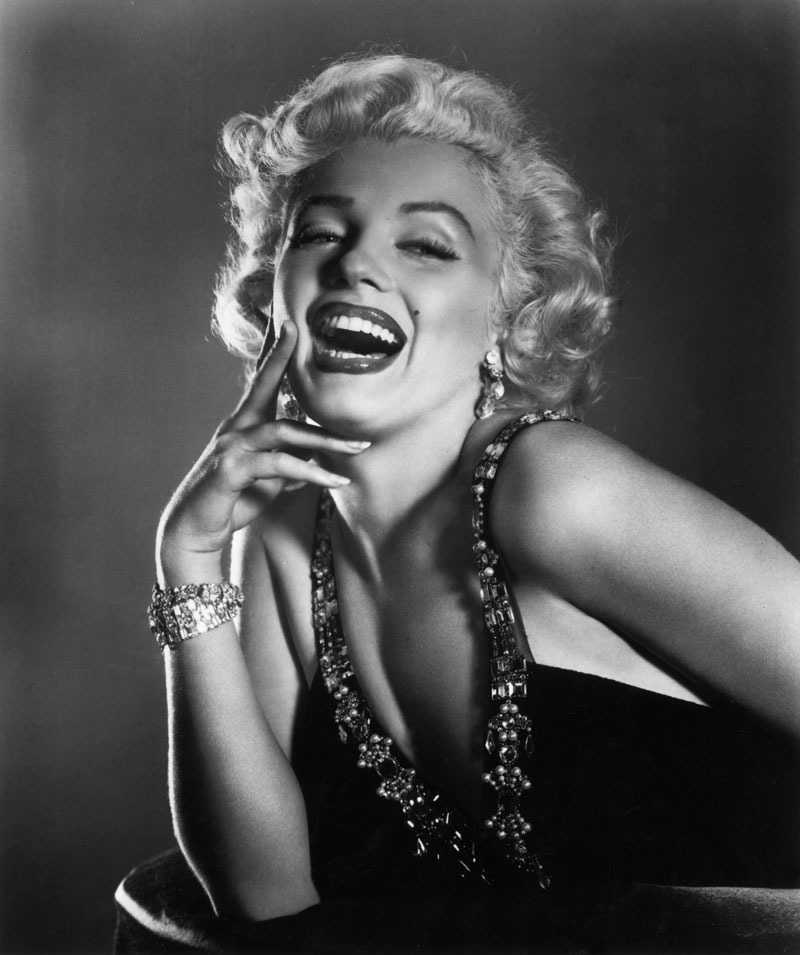
Marilyn Image Courtesy Hulton Archive / Stringer_GettyImages-3209439
circa 1952:
Like Monroe, Jayne Mansfield was a brunette-turned-blonde, curvy, and invested in the upkeep of the character she projected. She was also a trained pianist, violinist, and a fluent speaker of several languages.
Jayne’s upbringing was also patchy. She was born Vera Palmer in Pennsylvania and was three years old when her father died of a heart attack while driving with young Jayne in the car. Jayne moved to Texas with her mother and stepfather and at 17 she married Paul Mansfield. They moved to Los Angeles where Jayne pursued acting.
Jayne also understood how to appeal to the camera lens, garnering her fame mainly from publicity stunts that kept her name in the papers, more so than for her films. She had a rumored wardrobe malfunction at a film premiere in Florida for Jane Russell’s Underwater! Where her bathing suit top peeled off when she jumped into a pool, revealing her famous bosom. There are conflicting beliefs as to whether or not it actually happened or was manufactured to garner attention.
Both Jayne and Marilyn wanted to be stars. Marilyn wanted to be a great actress while Jayne was more interested in the fame part, but the goal was the same. Sex appeal was the currency and power they recognized they had, so both built their identities around being desired.
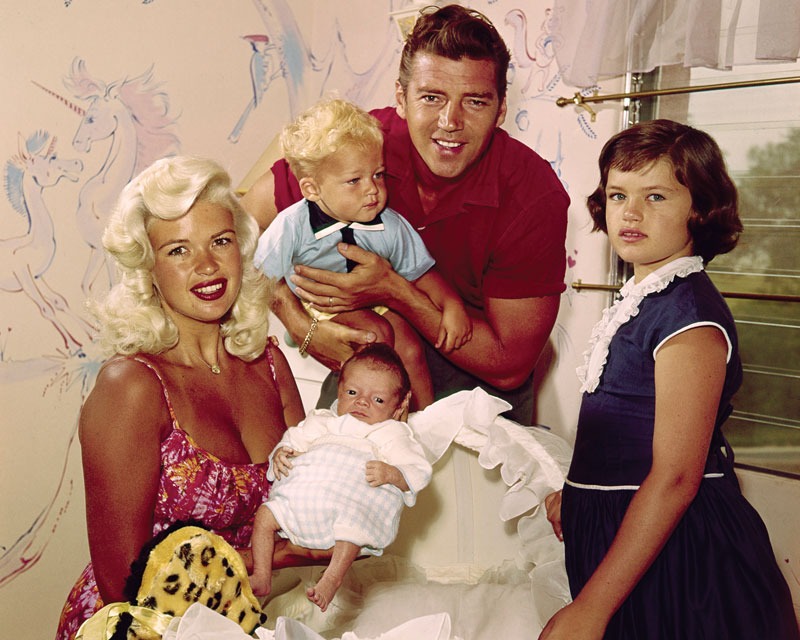
Jayne Mansfield (1933 – 1967) with her husband Mickey Hargitay, and children Jayne Marie (right), Miklos and baby Zoltan, 1960. Photo by Silver Screen Collection/Getty Images
The Other Marilyns
After Marilyn and Jayne, a string of “other Marilyns” came on the scene.
British actress Diana Dors was dubbed the “English Marilyn”, immigrating to the US in the late 1950’s. She was cast in a series of forgettable films, possessing the sexy, curvy blonde look but lacking the “It factor” that Marilyn had and the media prowess that Jayne exercised.
Mamie Van Doren, another buxom blonde of the era, was signed to Universal. Once her contract was up at the studio she struggled to get cast, ending up starring as the sexpot blonde in a series of b-movies. She later retired from acting, disturbed by the deaths of Monroe and Mansfield.
Kim Novak was another of the pseudo-Marilyn’s but managed to escape the system. She starred in Bell, Book and Candle and alongside Jimmy Stewart in Hitchcock’s Vertigo. But like Van Doren, she stepped away from Hollywood, saying “I decided to walk away…not wanting to fall prey to the tragic endings that often result when stars and sex symbols get lost in an identity crisis.”
Likewise, Brigitte Bardot was Monroe’s French counterpart who retired from acting at 40 to focus on animal activism. Like Novak, Bardot saw what happened to the sex symbol archetype in show business and she opted out.
By the late sixties and early 1970’s cultural tastes had shifted. People were breaking free of the stuffy 1950’s, women’s rights movements were becoming more mainstream, and sexuality was more free and openly expressed. The Marilyn Monroe type faded away with shifting ideals and the world moved on.
The Enduring Stereotype
The blonde bombshell archetype and stereotype still echoes today in some form or another. Pamela Anderson, Anna Nicole Smith, Paris Hilton — all women who played (or were molded into) the role of the beautiful ditz, only to later try to reclaim their humanity.
Each of them has paid a different price, the least of which is being labeled as a dumb blonde.
Like Marilyn and Jayne, Anna Nicole Smith died much too young of a drug overdose after a life of being ridiculed for her weight fluctuations, among other things.
Pamela Anderson fought and lost for the rights to private sex tapes she made with husband Tommy Lee after it was stolen from a storage unit at her home. Pam has managed to reclaim her identity though by recently returning to the screen in The Last Showgirl and championing a natural, makeup-free look.
Paris Hilton has also reclaimed herself as a businesswoman and mother, owning her own narrative in her memoir, Paris: A Life Story and happily raising her family while she does what she loves.
Saving a Legacy
Marilyn and Jayne were both self-made, talented, witty women who were eclipsed by their own beauty and the willingness to perform the part of ditzy blonde. They were sex symbols who were swimming against a cultural rip current that celebrates sex appeal and ignores talent and intelligence. Marilyn and Jayne became trapped in their own personas and the empty projection of male desire.
My Mom Jayne rescues Jayne Mansfield as the airhead blonde and resurrects her image as a highly intelligent woman who was another victim of the Hollywood branding machine. Where so many films about Marilyn reduce her to a life full of tragedy, My Mom Jayne tells and shows us that Jayne was more. A complex person. A musician. A mother. A woman who, like so many others, deserved to be seen.
Main Image Courtesy of Michael Ochs Archives / Stringer_GettyImages-562903949

