


Meet the female first responders in front and behind the camera of Chicago Med, Chicago Fire and Chicago P.D.
From One Chicago come many stories of strength, connection, and compassion. When the beloved suite of dramas – Chicago Fire, Chicago P.D., and Chicago Med – returns to NBC this fall, these interlinked series will arrive with a legacy of love for and by the professions they portray. As they enter their 14th, 13th, and 11th seasons, respectively, the Chicago-verse continues to expand. With over 9 million viewers per episode, they are NBC’s most-watched series. Perhaps it’s their commitment to realism, or the sense of comradery both onscreen and off, or the romances that emerge between emergencies.
Trauma. Car accidents. Murder. The One Chicago series’ do not shy away from the oftentimes grim reality of working as a paramedic, firefighter, or police officer in one of the nation’s biggest metropolises. Much of the commitment to grit comes from the insights of script advisors who worked in the field – people like Michele Martinez (Chicago Fire paramedic consultant) and Susie Schelling (Chicago Med set medical consultant).
Martinez, who recently retired from Chicago FD in 2002 after 20 years in service, works directly with the writers and actors to ensure they reflect the on-the-ground reality of fire paramedics. From joining on ambulance ride-alongs, to guiding actors through the precise steps of intubations, Martinez lends her own lived experience to help shape the show. For her, the chief concern is accuracy and carrying on her high standard of care procedures. “Did I follow everything right? Did I properly treat the patient? And did I give them the best care that was warranted according to my standing medical orders?” recites Martinez, who sat down to chat with BUST about her experience on set and in the field.
But what’s more compelling is that the Chicago series speaks to the truth of its storytellers. “It gets real through the writing because they do listen to our stories. The writing is just amazing, and then when it comes to portraying, the actors really touch into it. I’ll start crying because I’m reliving that call all over again. The actors are so wonderful. So they make it real. We had a lot of backlash when this show first started, like, ‘Oh, that would never happen’, and ‘that’s not how it is.’ And I’m like, yes. 24 hours in Chicago. That all happens in one shift. Anything can happen.”
Martinez says working on the show shifted her perspective on working in the field. “I can’t say I have an understanding of bravery or courage, but it made me realize that my profession is perceived that way, which in turn humbled me because we are so accustomed to going in, and we don’t think that that’s brave. When I was intubating somebody who was in cardiac arrest, at the time, I didn’t care about me. I cared about him. So that’s when I say I don’t understand the bravery or the courage. We just do it… All it takes to save a life is not to be scared.”
Schelling, who was an operating room nurse for 30 years and currently advises on set with Chicago Med, coaches the team on everything from following correct operating room procedures, to accurate wardrobe styling and proper holding of medical instruments. “I love being able to teach my craft to the actors and to the directors and show everyone exactly what I know a nurse does,” she said. “In Chicago Med, they take all the tips and hints as seriously as possible because they would like it to be as real as possible in the telling of the story.”
It’s real enough that professionals across all fields have reached out to the One Chicago production teams and crew with gratitude, says Jessy Schram, who plays Dr. Hannah Asher on Chicago Med. “I’m actually surprised to hear how many healthcare workers watch our show. It’s a little intimidating knowing they’re watching, but I’m always told how much appreciation healthcare providers have that we’re sharing the stories that we’re sharing. It opens the door to share more stories, and I feel like it gives them an outlet. In this way, I feel you get to understand where they’re coming from and bring it into the show,” she said. Schram’s brother, a fire lieutenant, and sister-in-law, an E.R. nurse, provide her extra notes for realism.
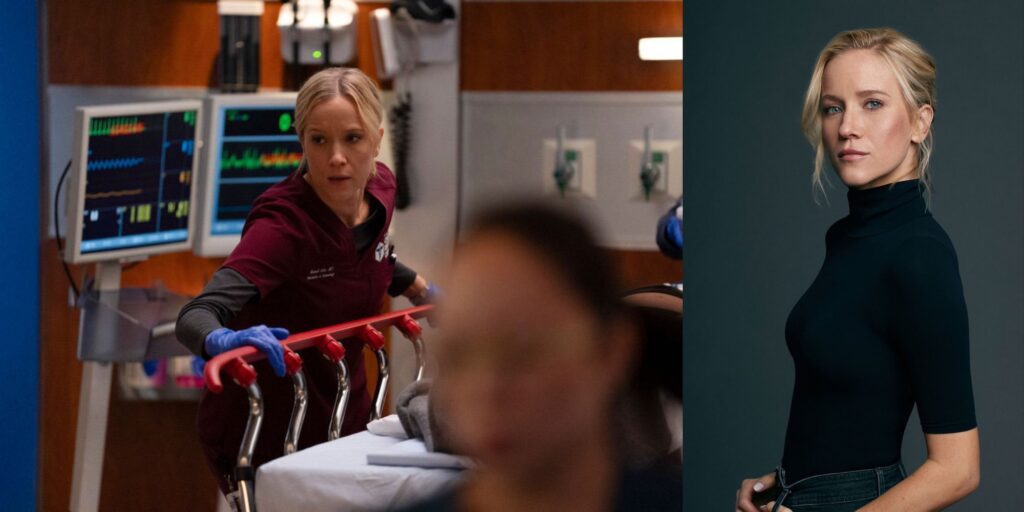
“It’s always fun to unlock this source and wealth of information of what people want to share of their experiences. And so many people that aren’t in the healthcare industry will share just how much they feel like they get to go behind the curtain and realize that these people are human too, as opposed to, you know, machines doing surgery,” she said. The shows honor the messy complexity of being a human; Schram’s Dr. Asher, for example, is a recovering addict.
One Chicago’s actors and storylines take the emotional truth of the professionals watching to heart in their performances. Jocelyn Hudon, who joined Chicago Fire relatively recently as paramedic Lyla Novak, says these stories have helped her grow her character. “We work with a lot of first responders. Hearing their stories and portraying them has been such an honor, and they have such a hard job. To do it over again is so, so brave, and I try to do everyone justice in my role. I don’t think they’re meeting anyone on their best day when responding to a call, but they have great stories, they help people, and they change people’s lives.”
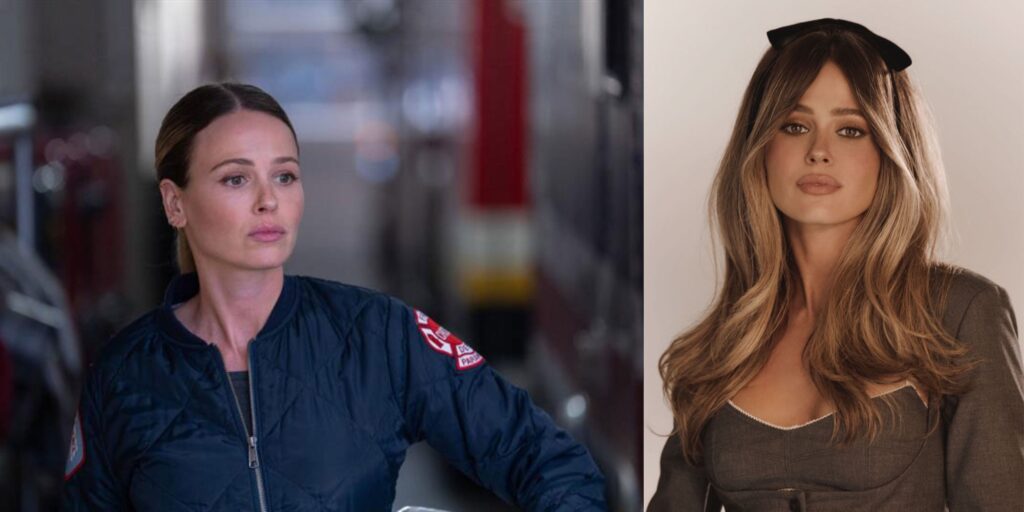
The show’s often visceral details (like when a patient sneezed his guts out of his body) provoke real reactions. “You don’t have to do anything as an actor. You just see the makeup and you see the other actor playing the scene and all the reactions are very real from me personally. Everything’s done so well, you don’t really have to use your imagination that much,” Hudon said.
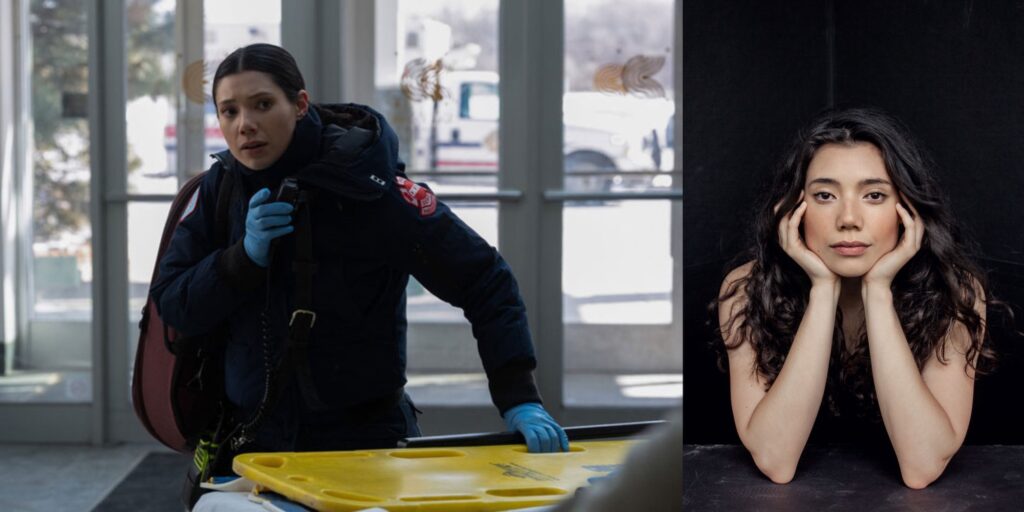
Hanako Greensmith, who plays character Violet Mikami on Chicago Fire, enjoys portraying the Windy City’s real tenacity. “One thing I love about having the gift of portraying Chicago in the series is, I think Chicago folks and Midwestern folk are very hard-working. There’s a grit-your-teeth-and-do-the-best-you-can-with-what-you’re-given element to the culture of the people here, and I hope I think that’s infiltrated in the show, too, when we’re a show of first responders,” she said.
Schram, a native to Buffalo Grove, says the series captures the spirit of the hardy and hearty city. “I feel like it’s really true to Chicago and Chicago natives, and I feel like we also get the work ethic of Chicago right. I feel like there is this different energy and this different vibe, people just want to go and do the best job that they can do and also go home and eat dinner with their family.”
Working together is a big part of the Chicago-verse. If old school M.D. or P.D. shows emphasized the doctor or the officer, One Chicago emphasizes the team. The familial camaraderie extends to the cast and crew. “Everyone’s very funny,” Hudon said of her Chicago teammates. “It’s very important to have people who don’t take themselves too seriously, who can make fun of each other and razz each other and support each other. I think that’s the perfect combination for a cast.”
One of One Chicago’s most enduring cast members is Marina Squerciati as Detective Kim Burgess, who has been with Chicago P.D. since the beginning. “I’m lucky enough to have played a character that has changed a lot. She went from someone very green to someone that’s now the senior most female on the team, so there has been a natural evolution,” she said. Now in season 13, “Burgess is really owning her power. I like being in charge of the fray, not being in the fray. It’s sort of my mantra for this year. I like that, as a woman, I’m in charge, I’m in control, and I’m in command.”

Burgess’ self-contained confidence has inspired viewers to pursue a career in law enforcement. “I’ve had a lot of young women come to me and say they want to be a police officer because of me, which is humbling and wonderful, and to have more good people in that role would be so wonderful,” Squerciati said. The playing field has changed over the course of Chicago P.D.’s time. “I talked to a lot of female officers when I first joined, a lot of the advice I got in the beginning was like ‘don’t show weakness’. That’s hard to hear as a woman, that you have to be twice as strong to show that you’re competent.” She adds the bravery it would take to be an actual officer “is pretty incredible. I am not a person that runs towards the fire. So God bless the people that do.”
Squerciati is excited for what the new season brings, including a new character. “I know nothing about the character and I’m excited. Just generally, I hope there’ll be a relationship fostered between actor and actor; but also, to see on screen what a new buddy and detective can grow together will be interesting as well.” For the on-screen couple of the recently married Burzek (Burgess and Adam Ruzek), things should finally be steady after many ups and downs throughout the years. “The drama isn’t her relationship. We’ve had so much drama there and that’s the boat that they’re on, the yacht on rocky seas. Nothing’s going to shake the boat. They’re steady and the world will be crazy around them.”
For long-standing characters like Detective Burgess and Dr. Asher, the actors often collaborate directly with the writers to guide the next steps of their journey. “Our writers have always had their door open to hearing how we’re feeling and how things are resonating with us as we’re going, which is a luxury. They really respect that we’re living and breathing these characters,” Schram said on working with the writers.
In this upcoming season, Dr. Asher is pregnant – which was Schram’s idea. “I did speak to our writers maybe a year or two ago and was like, ‘How cool would it be if an OB was pregnant on the show? You just get to understand and see it on a different level,” she said. “I’m so stoked that Miranda [Rae Mayo]’s character is also pregnant, because I feel like we’ll be in parallel universes while obviously dealing with different things, because pregnancy brings a different element for everybody.”
Miranda Rae Mayo, who joined Chicago Fire in season 4 as Stella Kidd, finds fulfillment through a commitment to service both onscreen and off. “I feel like one of the ways that we are alike is we both feel most fulfilled when we are of service to our community,” said Mayo, who serves on the board of directors for the youth mindfulness nonprofit Holistic Life Foundation. “She’s so passionate about giving to the community, especially young women. Empowering young women is so important to her, and I really relate. That’s where I feel most fulfilled. I am most proud of who I am when I am of service.”
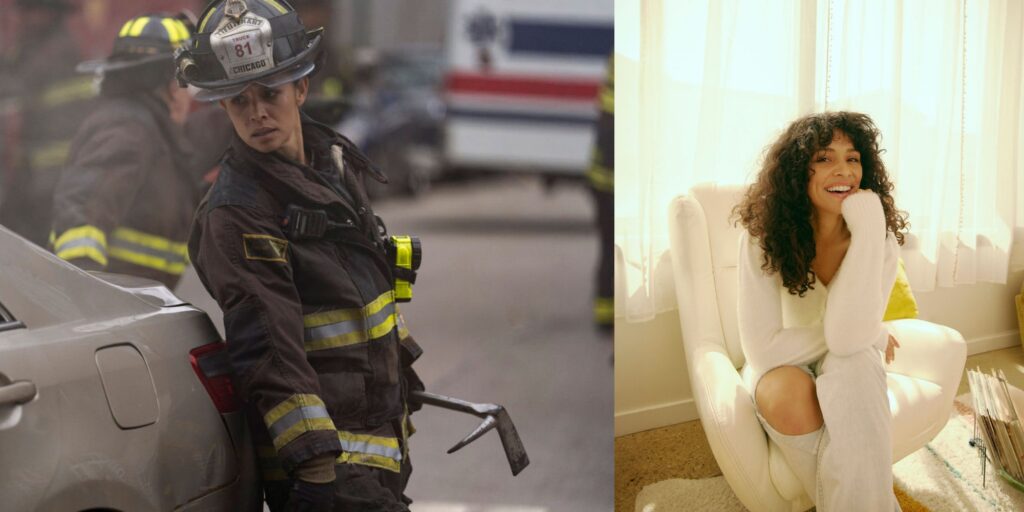
For Mayo, her role is about “integrity, like being all that you are, no matter what space you’re in, no matter if you’re clocked in or not. I feel like firefighters really embody that in a way that’s so beautiful and essential.” For Stella’s upcoming motherhood journey in Season 13, Mayo was inspired by real-life stories of firefighting mothers. “Moving forward into the journey of motherhood, is an opportunity to show up for the young ones that you’re caring for, and to be an example of bravery and of service. Yes, it’s life or death and the stakes are high. You ask firefighters, ‘Are you scared every time you go into a building and that could be your last moment?’ We’re all going to die — that’s something that is inevitable. But like, what kind of life do you want to live in the meantime? And what kind of a person do you want to be in the meantime?”
These life-or-death questions lend to self-discovery. For Greensmith, her character’s steady calm inspires more confidence in herself. “Violet’s feisty, competitive, there’s this deep, intense knowing of her own worth,” she said. “I do feel like there’s such a brazen, authentic honesty that comes from her that you actually don’t see a lot in women. I think women, oftentimes we’re masking. We’re trying to appease the parties that we find important, and I think there’s merit in that, but I think there’s also power in not feeling like you have to do that. I think by her having that innate quality, it’s gifted me a lot of my own inner work of trying to bring the same elements to my waking life.”
Through their characters, the cast and crew of One Chicago have expanded what it means to represent their respective fields on TV in fields not always receptive to women. “EMS has changed a lot. In the 80s, women going into the fire department did have a lot of backlash. They were not accepted because they were women. Those women put up with a lot, they paved the way to show that we can do this,” Martinez says. “I’ve been told a million times not to do this job. ‘You’ll never be able to handle it. You shouldn’t do it. You’re a woman.’ The job is physically tough and mentally draining and it will harden you. It’s a calling, and you either have it or you don’t, but you won’t know what you’re capable of until you try it. It’s not all about the blood and guts. It’s about working under pressure side by side with your partner. That one real save will make you realize all the hard work is worth it.”
“I believe it’s become a lot more collaborative,” Schelling said of the medical field. “When I first came out of school, it was: ‘Yes, doctor.’ I think as a rule, as women in that profession, in nursing in particular but teaching as well, we didn’t speak up for ourselves. The power structure is different now. We have things to offer and we can work together much, much better.”
The expansion of the One Chicago cast and storylines reflect an expanded view of who can serve in the ranks, and whose stories are told. “It has always been a massive gift to portray the only Asian female this show has ever seen, I will never take that for granted,” Greensmith said. “Although I cannot always see the viewers, I have such faith that there is a young girl watching this show that feels inspired or feels validated by whatever representation of Violet shows up that day. It’s such an opportunity to practice gratitude for being able to share this story, even if it were for just that one person.”
Ultimately, Schelling says, One Chicago has helped depict the humanity on both sides of the operating room, firehouse, or precinct. “I really feel I love to be able to translate real life to film and do the blend, so that everyone can see that that medicine is approachable and that it’s human beings behind it. People who cry, people who eat, people who love and hug, and people who are mad sometimes. We can see all the elements that go into a human.”
Main image: Hanako Greensmith and Jocelyn Hudon in Chicago Fire (Courtesy of NBC Universal Pictures)

