


“The Office is my favorite show of all time, so when I found out it was connected, I was just freaking out,” Chelsea Frei swoons as we sit down to discuss her new NBC program, The Paper. “This process, from start to finish, has just been like, pinch me, pinch me.”
In the show, the documentary crew that immortalized Dunder Mifflin’s Scranton branch is in search of a new subject when they discover a historic local Midwestern newspaper called the “Toledo Truth Teller,” and the publisher trying to revive it using volunteer reporters. Created by Greg Daniels, the same showrunner who spearheaded the American adaptation of The Office, along with Michael Koman, known most recently for Nathan For You, their new sister show is very much in the same vein as the beloved series that made Daniels a household name. The Paper is a wickedly smart, dryly sardonic mockumentary about local journalism that tugs on the heart strings just as much as it draws a laugh.
Starring an ensemble cast for the ages, The Paper is firing on all cylinders. Sabrina Impacciatore leads the motley crew as Esmeralda Grand, the wholly charming yet highly manipulative managing editor of TTT online and the interim managing editor for print. Chelsea Frei stars alongside her as Mare Pritti, the jaded compositor who has all but given up on her dreams of becoming a real bonafide journalist until her new boss Ned Sampson (Domhall Gleeson) strolls in, and Gbemisola Ikumelo shines as Adelola Olofin, the quirky accountant turned volunteer journalist whose sugar addiction is always on full display (“She loves sweets,” Ikumelo smiles, bragging that she’s “particularly proud” of the big jar of candies on her character’s desk that “literally just says, ‘Hands off Adam’”). Soft spoken Ramona Young steals hearts as Nicole Lee (most notably, that of her smitten coworker Detrick Moore, played by the undeniably charming Melvin Gregg), and though she starts out as the reserved underling to her fiery boss Esmerelda, she begins to find her own voice through her newfound writing position amongst her peers.
“I grew up watching The Simpsons,” Young relays, adding that she’s been a longtime fan of Daniels’s work. “At the first table read for The Paper, having everyone from the studio sit in the room, you could just feel the electricity buzzing, because there was so much anticipation. I was so moved and honored to be there. I ran into the kitchen and started crying, because I was so happy. It was magical.”
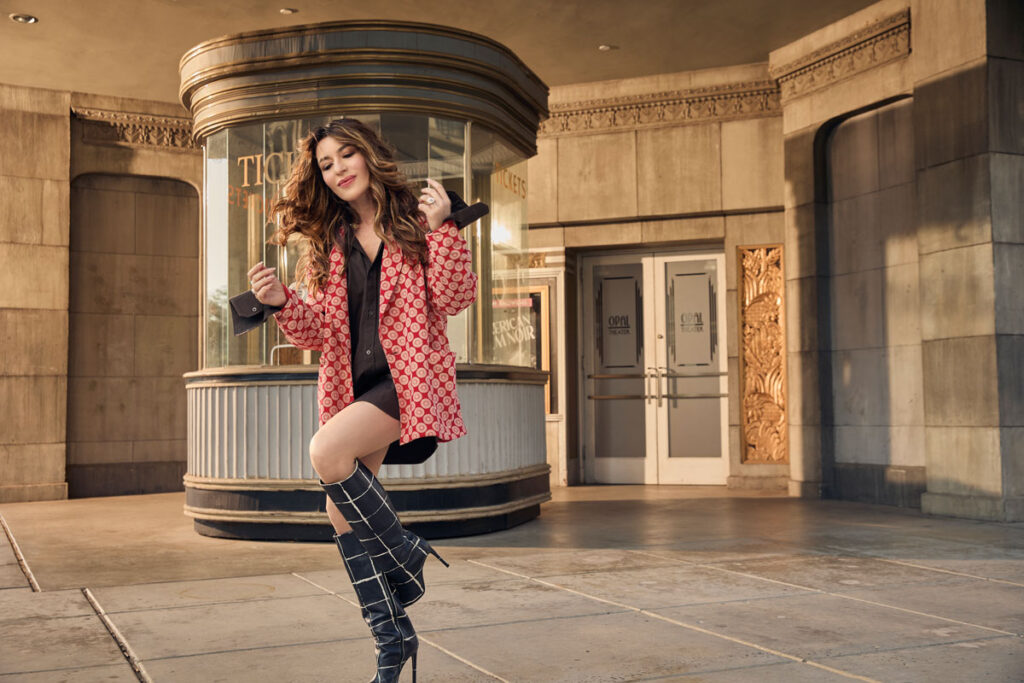
One woman’s ticket to paradise is another woman’s terror tram, as Impacciatore reveals that stepping into Daniels’s world initially made her a little nervous. “You don’t imagine how scared I am, that sometimes I can’t sleep at night,” she admits. Even after winning over millions of viewers with her appearance as Valentina in the second season of The White Lotus, the world renowned actress still understands that her new role carries significant weight. “Like, how are people going to accept Esmerelda, you know? Because after The Office, with such an unbelievable cast, with such a high level of acting, and being asked to wear these huge shoes. It’s really frightening. Of course I’m excited, but I’m so scared.”
Ikumelo, who serves as a writer and an actor on the series, may not be as familiar with Steve Carrell’s shenanigans, but that doesn’t mean she isn’t hip to the lingo. “Obviously, as a British person, I’ve known the UK version of The Office and how the American version became this entity that spoke into the zeitgeist,” she says. “I knew so much about what it is just from it permeating the consciousness. I think I was saying ‘parkour’ for many a time before I even knew it was an Office reference.”
Characterized by both Daniels’s signature dry humor and his willingness to branch out into unfamiliar territory, he and co-creator Koman have crafted a television show that is as poignant and timely as it is just plain pleasant. Their secret? Quite literally shaping The Paper around the women who star on the show.
“It was a very, very long auditioning process,” remembers Young. “It took over a course of several months, and I did tapes for it. I came in for a chemistry read, and then on the last round of auditions, I basically sat with Greg and Michael, and they just interviewed me about my life for an hour and a half before they made their decision.” For the co-creators, finding their core cast members wasn’t just about who can read their lines and hit their marks – it’s about adding feathers in their cap. “I think that they just enjoy working with people that they find interesting personally, and maybe people that they can draw creative ideas from,” continues Young. “And I was fortunate enough to be one of those people.”
Frei notes a similar experience during her audition process, saying she was also given very little to work with, other a fake character name, some dummy sides, and the nugget that the show existed within the same universe as The Office. “But that was the most amazing thing about Greg and Michael, as they were wanting to develop it around us,” she explains. “Obviously, they had the characters, but they were really interested in getting to know us as people. So, it was kind of like a backwards way of not being like, ‘How do I fit this part?’ And instead just being like, ‘Is this part going to fit into this person that we’re looking at?’ It was very intimidating and scary.”
Frier clearly had nothing to worry about, as Daniels and Koman both found her to be the perfect fit for their take on Mare. “I’m from Boston, and I think they were really responding to my abrasiveness,” she laughs. “I thought, ‘Oh she’s going to be a Boston girl, she’s going to have an accent,’ but no, not at all. She lives in Ohio and was born and raised there, but I think that energy was something that from the beginning, made her somebody who can go toe to toe with somebody. And I think that goes back to her military background.”
Upon learning about Frei’s own family history, the showrunners incorporated her real life into facets of her character. “My dad is a vet, and so are my cousins,” she says. “I got to talk to them and hear about what their experience was like in the military. I think it’s given [Mare] this harder shell and it’s helped her, as she is starting to figure out how to get stories out to people, and where to go for it, and where not. I think it informed all of her personality, really. She got used to a militant schedule, and she lives her life that way. She’s incredibly practical.”
Ikumelo, too, found working on The Paper to be an extremely inclusive experience. “Greg was very interested in hearing about my perspective, in terms of where I came from, and my background, and rooting the character in some of that,” she says. “I was talking about my immigrant experience as a Nigerian person, who was born in Nigeria and was moved by my family when I was quite young to the UK, and he liked that for the character. So, we did a similar thing, where Adelola was born in Nigeria, but moved with her family to Toledo. A lot of that stuff came from me, which was kind of a revelation for me.” She adds, “There was a moment I actually said, ‘I’d like her to have a more Yoruba sort of name, because in Nigeria, a lot of our names mean something,’ and I was allowed to do it.”
A brilliant artist whose writing shines just as brightly as her acting chops, Ikumelo used her unique perspective to dig in even deeper into the character of Adelola. “I wrote a Bible for the character and gave it to Greg, and there was a lot of stuff in there,” she says. “I wanted to move her slowly into burnout status, because up until that point, she was quite an overachiever. She peaked at college, and she’s done with it. She just wants to do the numbers thing and go home, come back, and get her money at the end of the month. So her costume, for example, she’s in this arrested development from college, so she still dresses like a quirky hipster goth student, and we gave her a septum piercing.”
Little did she know, life would begin to imitate art. “I slowly started coming into the writers’ room dressing more and more like Adelola,” blushes Ikumelo. “But it was a really great opportunity that you don’t always get as an actor, to start trying things on for the character. It makes it so much more freeing.”
Young has been so transformed by this unique experience that she might be ruined for all other impending projects. “I have never been so involved in character building, and interactive in that process as I’ve been on The Paper,” she says. “I do a lot of work on my own, and usually I show up on set and I’m like, ‘This is what I have,’ but Greg is so collaborative, and so is Michael, and I’ll bring in anything from the journals that I write in as my character, or ideas or pictures that inspire me. They really want to be involved in that process, and I’ve never been so transparent about it. And I don’t know if there’s any turning back after this.”
For Impacciatore, a native Italian who garnered acclaim overseas before gaining followers in America via the world of Mike White, her biggest concern was that she might not be able to nail the dialect in time – or at least, craft a believable vernacular for a character based in the United States.
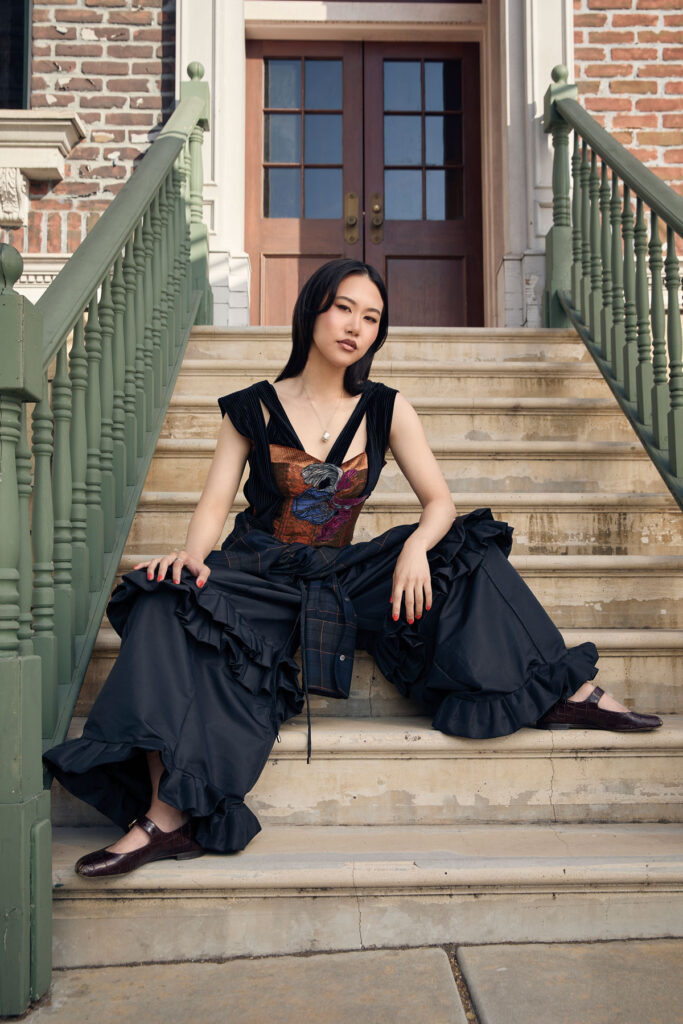
“At first, they asked me to learn an American accent,” she says. “And then they called me and they said, “Sabrina, we changed our mind. We love your accent. We’re going to rewrite the character, she’s not American anymore. She’s an Italian that moved to the U.S. and probably married an American guy, and she had a kid with him. Now she’s divorced, but she doesn’t want to go back to Italy. ”
Boiling with ferocity on the outside and battling insecurities on the inside, Impacciatore decided that Esmerelda’s bravado would reflect in the way she carries herself, but also, in the manner of her dress. “She needs success,” muses Impacciatore. “She wants to stay here, but she’s not good at anything. She’s not a good journalist. She doesn’t know anything about journalism. But maybe she can use this camera crew to become a star. One day, I started to think like this: she’s going to have hair with waves like an old fashioned diva from the fifties, like Rita Hayworth in Gilda. Also, she wants to appear nice looking, like seductive, so she’s bringing her own lights. These little things gave me a key to playing the character, and I really loved that Greg and Mike were so open to listen, because I am a very instinctive creature. I’m like a wild animal. I feel things in my gut.”
She adds, “I was imagining during the next Halloween party, I would love people to say, ‘I want to dress up like Esmerelda.’”
In the season opener, Tim Key’s Ken Davies informs the documentary crew with a smirk that as head of strategy for the paper’s parent company, his job is to, “innovate sales products made out of paper. So, that might be office supplies, that might be janitorial paper (which is toilet tissue), toilet seat protectors, and local newspapers – and that is in order of quality.” Clearly amused with himself, Ken’s comments on the ephemera he absentmindedly oversees act as both a jumping off point for the show, as well as a bittersweet reading of how many citizens feel about the current state of journalism in America.
“I’ve always felt that comedy and art in general has always been a beautiful way of reflecting society,” Ikumelo tells me. “I can’t really speak to the journalism of it. We’re leading with funny, but there’s always truth within that funny. Laughter lowers your defenses.”
“This isn’t a literal documentary,” she’s quick to add. “This is a comedy, first and foremost. And I’ve always loved and respected the ability of comedy to hold up a mirror to who we are as a people, and the tragedy, and the dark things, and laugh at them, and get some sort of respite from the darkness. There’s something freeing in laughing at the pain, you know? It’s just a beautiful, necessary way to communicate information for the people and stories for our time.”
As the crew follows Ken around the building, he monologues to the camera, telling them how the entire establishment was once the old newspaper tower. (“Can you believe they used to employ over a thousand people?” He balks incredulously. “That’s absolutely insane!”) His arrival on the eighth floor is marked by a lethargic gathering of melancholic cubicle dwellers meandering around their desks, dissociating. With the bang of a cheaply made gong, we’re introduced to the final remnants of the once great and powerful Toledo Truth Teller. Esmerelda brags about having a nose for news while being completely oblivious to the building burning just off in the distance, in the window directly behind her. Mare demonstrates to the documentarians how she copies and pastes stories online, or at least tries, before her old school computer overheats and shuts down. “I once wrote for ‘Stars and Stripes’, the military newspaper,” she reminisces about her days back in uniform, a wave of nostalgia briefly washing over her face.
Altogether, it’s a pretty depressing scene. Things are looking quite abysmal for the old Truth Teller – that is, until newbie journalist Ned Sampson spills in, boasting to the camera about how he always wanted to be Clark Kent, but coming off a tad more like Jimmy Olsen.
“I think Mare is a little overwhelmed by his almost toxic positivity, and feeling like, ‘You’re so naive, you have no idea how hard it’s gonna be to make any of this happen,’” says Frei about her character’s initial reaction to meeting her wildly optimistic new boss. “She’s not wrong, to a certain extent, but I do think that shifts as she sees how much he cares, and that he could maybe help her make her dreams of being a journalist come true.”
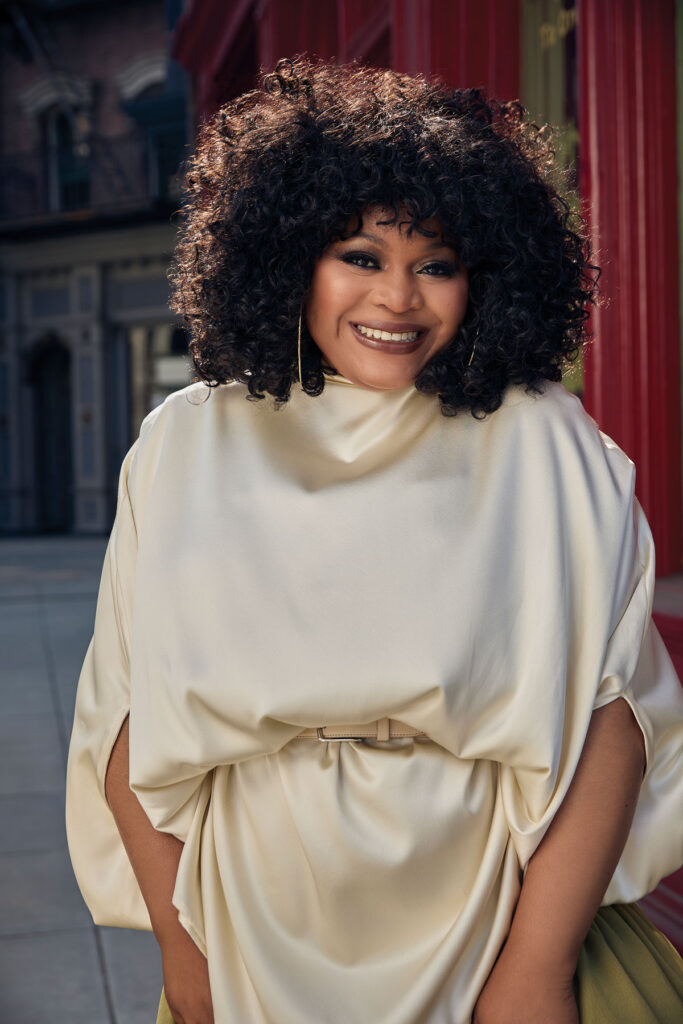
Ned uses his first day on the job as an opportunity to wax romantic over his love of journalism. Much to the horror of Esmerelda and Ken, Ned announces his plans to shake things up and reinvigorate the paper into something worth reading again. He wants a full staff and multiple local beats. He also has ideas about freeing up funds by cutting some other things, like the wire services, and all of the “clickbait nonsense.” Faced with a budget crisis, he offers up the idea that perhaps the already existing employees on the floor can write for the paper as volunteers, at least to start. His suggestions are met with nervous chuckling. Having grown so accustomed to a laissez-faire type of working environment, Ned’s new coworkers are so mystified by his strange enthusiasm and uber positive prowess that they actually lock him in the copy room upon his initial arrival, afraid that he might be an unwell person who wandered in off of the street.
“I love the first episode, when Mare and Ned are getting to know each other, and she doesn’t want to say too much about what she feels about the paper, but she also kind of wants to be like, ‘Dude, what are you doing? Get out of here!’” says Frei. “I think she’s gotten complacent. She’s given up on having hope, or having this career that she’s really excited about. She thought, ‘I can have a good life, and keep this steady job, but I’m never going to really feel like I did anything to make a difference.’”
Frei continues, “When this new boss comes in and re-energizes her, I think it’s really cool to see that all of sudden, she’s like, ‘Oh, maybe I could do something with my life that’s exciting.’ And I do think she chases this bigger dream of reporting. I think that’s always been what drives her. So I think that whole scene of watching her tell Ned what she feels, and then having him be like, ‘No, I’m the boss, we’re gonna change this,’ – I think that’s a very fun moment for her.”
Esmerelda, on the other hand, is a little less thrilled about her new coworker at the Truth Teller.
“She feels threatened,” says Impacciatore. “She feels she’s losing power here. Like, right away she understands that this is going to be an issue. This is going to be a problem. And he is a dreamer. He wants to change things. So, before anything even starts, she has to neutralize him as soon as she can, as much as she can. And I found that incredibly funny. I really had to do a big jump, because it’s very far away from me. I had to enter into that mentality.” On the show, Esmerelda and Ned constantly bump heads, as his progressive ideals seek to disrupt the old-fashioned foundation that has grown so familiar to Esmerelda’s daily routine. “I like the conflict,” she says, her eyes bright. “Conflict between us can create a lot of comedy.”
In Esmeralda’s defense, bringing in a younger man to take over a more experienced older woman’s position in the workplace is a tale as old as time, and it is one often fraught with ill intent. Gender discrimination and ageism are real, and common. Any woman who’s worked for most of her life can understand the apprehensive thought of a fresh faced pupil stealing the spotlight.
“This was my proposal to Greg and Mike: She’s manipulative, but in a childish way, like children can be,” coos Impacciatore. “Children can be very manipulative. They can be dictators because they need to get what they want, but they don’t even realize that they are actually denouncing what they’re doing. It’s like when a child wants to hide and leaves the legs outside of the beds where they are hiding. This, to me, was a funny idea to play with that she can’t help. She’s manipulative, she does bad things, but then you can see her game. And so I think that this could be the sweet part of her, also.”
Impacciatore points out that Esmerelda views everyone around her as competition – not just the men: “She keeps mentioning her little body. It’s stupid. She makes me laugh, because she would do anything not to lose power. But actually, what we see is her losing power, and doing everything she can to not lose it, to get it back.” She elaborates, “That’s why I wanted her to be a little bit crazy, so we can do anything. Also, to make this character lovable, because she’s really nasty. She says the wrong things – things that shouldn’t be said. She does terrible things with the girls. She’s in competition with every other woman. So, the idea that she can be theatrical, it can help to make her funny and lovable.”
Of course, Esmerelda’s “pick me” personality couldn’t be further from the woman who portrays her. “I believe in sisterhood,” emphasizes Impacciatore. “I was so lucky to have these girls, like Chelsea and Ramona and Bemy. They are fantastic human beings. I sincerely love them. I don’t have to make any effort. I just wanted to make it clear from day one, ‘Hey guys, I’m not competitive. I’m a loving person. And I want this site to be a loving place where we can play as children.’ Because we have to play as children to be funny, to be real, and to trust each other.” A few days prior to our chat, Impacciatore, Ikumelo, Frei and Young all modeled in a photoshoot together for the cover. “I was so happy to see them,” she beams, “To see their faces, to make these pictures together. We were having fun. And I told them, ‘Girls, let’s imagine we are a bitchy pop music band!’”
Impacciatore pauses, tearing up. “I felt that there is a real bond. I felt in my heart while we were playing, I felt, ‘I love these girls. I love them.’ Sorry, I’m stupid and emotional,” she sighs and grabs a tissue, wiping away tears. “It’s like, I love these girls. I love them as friends, and as artists. I love their acting. I don’t have to think about acting. I just have to react. This is the highest level for an actor, to be able to trust your companions, to be innocent, be childish, to be really exploring things, just reacting to each other. This is heaven!”
The feeling is mutual amongst the rest of the crew. “I love having lunch with the girls,” Young tells me excitedly. “Sometimes we’ll do a trailer situation, but a lot of times we’ll also sit in an actual cafeteria and pick the brain of whoever’s directing the episode that week, which is also a lot of fun.”
“I was such a fan of Ramona, and Never Have I Ever,” admits Ikumelo with a shy grin. “For the first few days, I was a little bit fan-girly. Like, ‘Hi, I haven’t really talked to you like a human yet.’ She giggles, “Eventually, you start seeing that they’re people. They’re amazing actors, and everyone’s just beautiful. It was a real joy to be on set, honestly.”
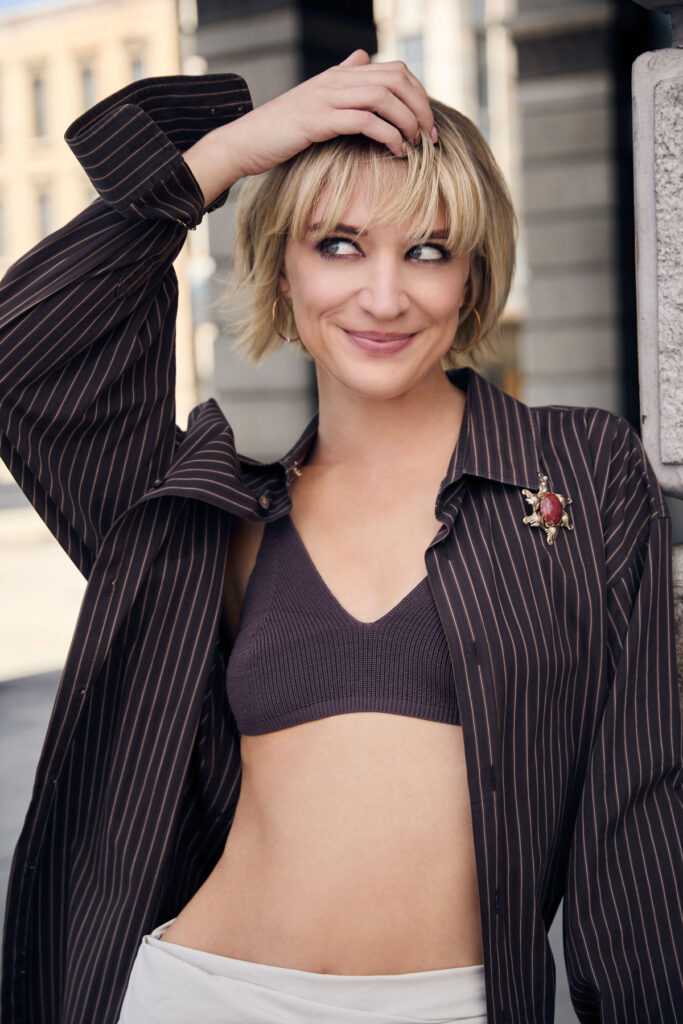
Technically, The Paper exists within the same universe as The Office, but Young politely corrects me when I refer to the new series as a spin-off show.
“I wouldn’t word it as a spin-off,” she says emphatically. “I think it’s its own thing, and it’s set in a parallel universe, with the same documentary crew, but it’s definitely unique, and special, with its own character arcs.” Young alludes to the return of actor Oscar Nuñez, who is reprising his role as the beloved Office employee Oscar Martinez, but insists that he and the camera crew are the only threads connecting the two programs – for now, at least. “I think it’s more dynamic, and the storylines are completely different, so people are gonna have a whole fresh new show to hopefully fall in love with,” she says, stressing the leap of faith required from all of the employees volunteering to write for the Truth Teller. “We’re trying to prevent a local newspaper from dying. There’s time at stake, and there’s the potential of a company falling apart. There’s constantly a lot going on that people actually care about. We’re all there because we want to be. It’s not like it’s our job. It’s beyond our nine to five.”
“There are elements to [The Paper] that I think Office fans, like myself, will be able to really respond to, and feel at home,” says Frei. “For me, personally, working in an office with Oscar is insane. He ended up becoming one of my best friends on the show. I’m obsessed with him. I think there’s a really sweet sense of hope, and wanting to build something together that is perhaps a little bit also of a departure from the original Office.”
They say that if a director is wise enough to hire the perfect cast members, then all they have to do during filming is sit back and let their actors work. This notion rings especially true in a show like The Paper, which is overflowing with highly intuitive performers – but it also helps to have the forethought to base a story rooted in journalism within the confines of a local newsroom.
“I mean, we always need to laugh, but there’s just something really lovely about the specificity of local news, especially in this world where we’re getting more and more polarized, and there’s more and more politics,” relays Ikumelo. “And we’re very keen to make sure that this show is not just the story of the day, so it ages in five years. Like, ‘Oh god, that person’s not even a president anymore! Why are we obsessed with that person?’”
Ikumelo clarifies, “The more local we get, the more specific we get, the more universal we get, because everyone can connect with the idiosyncrasies of their own community, and their own locale.” She tells me how being a part of The Paper has actually made her more invested in her local news in her own daily life, and how that fascination helped further infuse her character with a sense of compassion and ambition. “I became a little bit obsessed with my own local newspaper, because I was searching for stories that we could pitch. I learned that local newspapers are a trip. There’s lots of just like, ‘Eddie and his massive eggplant. It’s the biggest eggplant in the community!’ But really, it’s so necessary in terms of reconnecting with what is community, both in a wider sense of our community, but also, the camaraderie between teammates, and working together, and the sort of motley crew that we assemble. So, there’s a real timeliness of it, where we’re really striving for that, as a people.”
For Frei, the whole experience also hits her on a deeper level. “My Nana worked for my local newspaper my entire life,” she says, looking very proud. “I would do all the school plays, and she’d be like, ‘I’m gonna get you in the paper this week.’ I was like, ‘Wow, I’m a celebrity!’” Happily, she talks about her mother’s reaction to her casting on the show. “My mom is over the moon. She’s like, ‘You’re following in [Nana’s] footsteps!’ I’m like, “You know I’m not an actual reporter, though, right?’”
All Images Courtesy Of: Jsquared
Stylists Melina Passalacqua & Courtney Spitznagel

