


For 20 years–ever since their 2004 debut La maison de mon rêve–the sisters of Bianca Leilani “Coco” and Sierra Rose “Rosie” Casady have charmed and confounded listeners throughout their color-coated career. Musically, the duo continues to draw from diverse and diasporic music styles and tropes, inspired by the interwoven cultural-historical roots of their own nomadic and witchy upbringing. We discuss how they’re turning despair into inspiration, channeling spirits through art, drag, and more. When we spoke to CocoRosie, Bianca was just awakening from a long night of drawing.
What do you like to draw in your deep night inspirations?
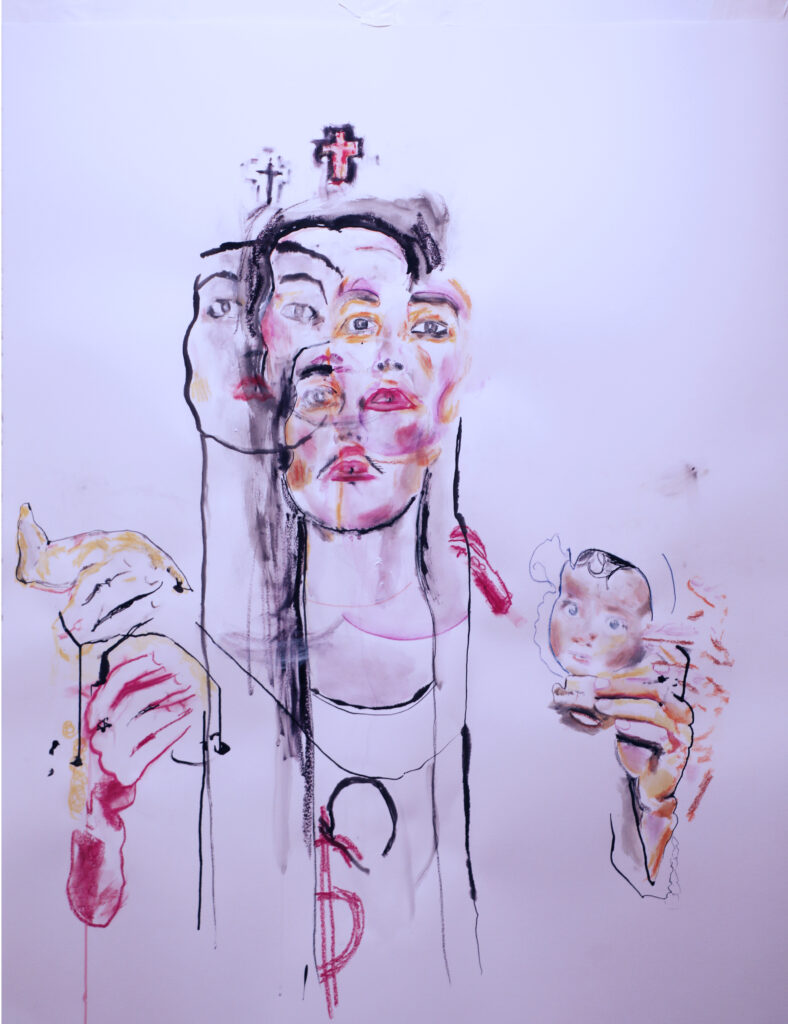
Bianca: I’m grappling a little bit with the extreme amount of violence that’s going on in the world, especially in the Middle East, and just trying to find a place to relate to what’s happening. Specifically, I came across this image that I created some years ago where I was sort of playing a dictator and I was holding a baby doll that had just already fallen apart, everything was connected by string. I came across the image and suddenly, I could see a Palestinian child. It was like the moment of now suddenly created meaning and context to this work that was not benign, but just being experimental and aesthetic, picking up things that were laying around. It’s hard to really grapple with things in the moment.
I’m thinking about creativity and time and time capsules, longer approaches, and not wanting to spit things out into the world so fast either for that reason.
Issues of trauma and darkness are not unfamiliar to CocoRosie’s art. Do you feel the crises in the world now are changing you as artists or making you re-examine anything you’ve done in the past?
Bianca: I have been quite aware of the modus of objectifying trauma through art and the concretization of making it into something, really seeing it both as a coping mechanism and at the same time a real tool of transmutation. With what’s happening in the world, somehow, at the moment, I feel invigorated and I’m starting to feel the edge, you know? We’re on the edge of nuclear war and ecological collapse and it could be just total despair or – suddenly I kind of got into the rush of like, really being uncensored and extremely present in this moment and not resisting the time that we’re in, but just completely embracing it with all of its precariousness.
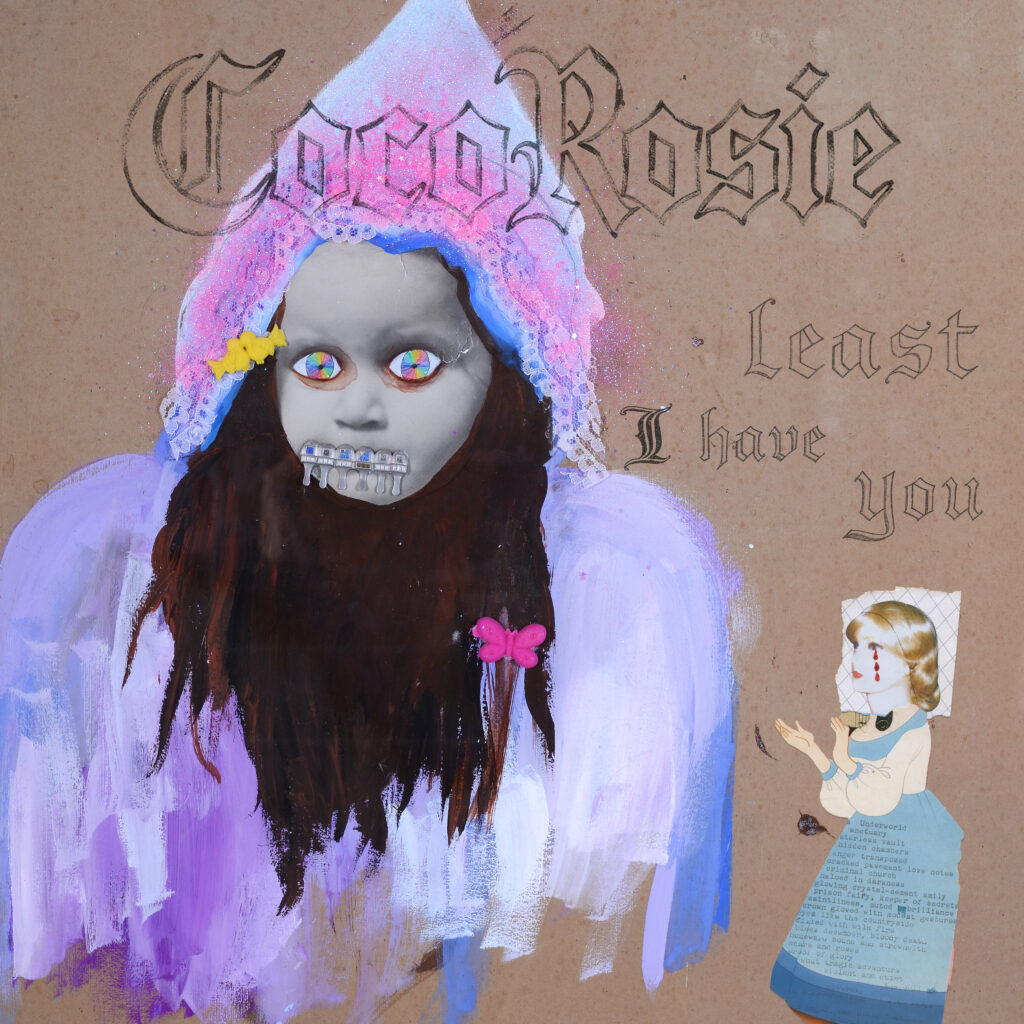
Your new single just released. It sounds really fresh and really new to me. Do you feel the same?
Bianca: It’s a good question. I think time, again, is a topic in our process. Some of our songs have been in the making for many years. I’ve been enjoying letting more time pass, even if it’s been circumstantial and out of our control. Arriving now that the time has passed, I feel, things are only getting more interesting in terms of how they meet the world. A lot of our songs are also quite kaleidoscopic and collaged in terms of their material and their production so I hear certain things in the drum production or something else that’s like, oh that’s tethered to this this moment and this particular obsession we had, or this instrument that we kept using and, you know, maybe we suddenly update it with what’s our newest obsession. So it’s actually something which is very accumulated and not it’s not something kind of done overnight. You could say to our detriment. We also reprocess our music so much in a kind of, you know, maybe overly digital way and there’s some yearning to get back to total restrain, an analog process. I’m glad it sounds fresh and I just think time is such an interesting thing. It’s almost like letting time go. It’s like it’s really letting something kind of ripen or like mature or like and then the world coming to a certain moment, where they meet. There’s something important about that.
Sierra: One exciting thing about the song is that we’re working with an artist, Greg Saunier. He drums for Deerhoof, but he’s been a guest on hundreds of records cause he’s an incredible artist. He’s drumming on this song, and we collaborated on the drum and beat production together.
Going back 20 years in time, what would you tell or advise your younger selves?
Bianca: I would just tell myself to lighten up, basically. It’s really in my 40s that I can relax and not try so hard. I always thought the secret to any success that I had was from this immense effort and being a really hard self-critic. It’s taken me a long time to get to just lighten up; to not overly identify with the painful side of life. I put it on like an outfit and kept it on for a really long time. There was a moment a few years ago, where I’m like, the funeral is over, you know. Just like, get out of the funeral attire.
Sierra: I feel so supported by Bianca, in the project style and in the meditative aspects of going into an art process, and having a creative partnership. For me, the most important thing really is my instrument. That’s where I could have been a little more responsible. If you want to be a singer, if you want to reach for the longevity of the voice, you have to do scales every day. I missed a few decades of scales.
I’m also curious, in those 20 years, what you feel has remained the most consistent? What hasn’t changed?
Sierra: The witch-hood that was passed onto us from our mother. That’s been really consistent in our art process.
Bianca: Our mother definitely modeled an extreme amount of passion and audacity that was a big step into putting our art into the world. There’s been a kind of unruly kind of momentum ever since then that we’ve been able to lean into which has a little element of magic. I think the artist is in a kind of magical practice because it’s a combination of will, risk, this kind of materialization of spirit. The art making process in itself already kind of goes there. It’s been in the center of our lives’ path.
I think both of our parents have a lot of kind of witchy aspects, and there’s a kind of light and a dark and we have it on both sides. We rejected one side for a really long time, but then we kind of started breaking through that with our 4th record, Great Oceans. We discovered an ancient kind of ecofeminist magic. We just had to come there on our own because, we’d been around so much ritual and ceremony, and even stuff that didn’t really feel fully authentic.
Sierra: In our childhood.
Bianca: Yes, in our childhood. I feel like it’s kind of cyclical, we’re coming back into that again. Even in our music making, there’s these mysterious happenings in some songs, and we have to allow ourselves to be slightly out of control in order for it to happen. A certain looseness, a certain level of experimentation and commitment to process, and it really only happens when it’s just the two of us. But some mysterious things come into the recording, they become like a very important force, even if it’s kind of in the background, you know, and then we observe these things and then we follow them. They become guides in the work.
Your music through the years has seemed to have a ghostly element attached to it, as if you’re not alone in your recording sessions. Do you have a sense that you channel that energy? Or is it just a coincidence?
Bianca: Well. Maybe both. Through our creativity, we do feel like channelers. Outside of it, I wouldn’t say it’s like this thing we walk around with. But it is intrinsic to our creativity, for sure. There’s this lack of judgment that we practice from the beginning, which allows things to come in, perspectives that aren’t our own, and it’s constantly an exploratory process.
And as a poet, I really practiced, especially when I was younger, the experience of just getting a download, like word for word. I would always have a small journal and it just comes knocking. I used to be even quite rude, so serious, so devout about receiving that sensation. I would just ignore everybody and protect it with my whole ego–I would create a fortress, to make sure that I was able to get everything down.
Somehow I think it has more to do with being artists than anything and of course, not all artists work this way, but we’re really not conceptual artists. We’re kind of receiving artists.
Sierra: I had an incredible experience, getting into this group with Bianca because I had been involved in classical music, and classical music is incredible. There’s a lot of room for the spirit to transform and find freedom, but it’s all based on form, finding the freedom within the form. When I met Bianca, I was very young and I felt like I was doing something naughty. And it was very exciting, because she was my sister, I was very uninhibited and unashamed, and I knew she wouldn’t tell anybody. I felt just so inspired and so free and I did everything that I wasn’t supposed to, you know, music-wise, and I just focused on breaking every rule. From there on out, I noticed that I developed as a person around that incredibly uninhibited space and this acceptance I felt from my sister and the secret space. Even though the work found its way into the world, there was this intimacy and this giddy, beautiful, wild breaking-free feeling that held through.
Do you feel in any way like you’ve contributed to the wider exposure or acceptance of LGBTQ+ art and music? or if you see yourselves as part of a different cultural thread, with regard to being openly queer artists?
Bianca: I think firstly we’re particularly unaware of what’s going on in pop culture and music and have always been like that. But in terms of the street and the metropolitan American reality, New York is unbelievably different from when I moved there as a teenager. The amount of different types of couples just holding hands in the street, I can just say that that just absolutely wasn’t happening. Recently I was walking with a beautiful woman and getting compliments from so many different types of people. I can remember moving there at 17, and I wouldn’t have dared hold my girlfriend’s hand on the street. I was shocked and I was touched. Things have really changed and there’s a different level of humanity going on, at least in this topic.
In the beginning, we were already sort of playing with our own sort of trans identities in somewhat of a persona kind of way. For me, it’s always been integrated into a creative persona. It’s personal, but there’s this element of play. I’m identifying more with drag, we’re heavy into drag. It’s curious to me. I’m a very psychological analytical person, so I constantly investigate this: why am I going through a kind of male direction to get back to a female direction? What is it with my femininity that is disempowered? It’s this kind of Russian doll of things that we all contain in our associations, in representations of gender that are so personal.
In terms of gender morphing, it’s come up a lot in this record, when we were in the studio, we filled the studio with high heels and we even got a stripper pole put outside of the studio. I’m terrible at it. We just worked the pole from the ground but we couldn’t get up it.
Sierra: Yep. It was hard. It was hard.
Who or what is inspiring to you right now?
Sierra: In terms of who, we have a very close friend and soul sister who’s Lebanese. And she said to us last night, “I’m just trying to be strong and I don’t want my heart and imagination to be colonized.”

